Quality issues with self-drilling anchor bolts from China can stall a tunnel or slope project overnight ASTM specifications 1. I have seen buyers panic, blame everyone, and still lose money on our side of the trade.
Handle quality issues with self-drilling anchor bolts from China by documenting specifications before ordering, inspecting goods on arrival, separating factory defects from installation errors, then filing a written claim with photos, lot numbers, and test reports, and requesting a specific remedy such as replacement or refund.
A claim is really an evidence problem. If you can prove what you ordered, what arrived, and how it deviated, you win. Let me walk you through the whole process step by step.
What Quality Issues Should I Watch For When Importing Self-Drilling Anchor Bolts from China?
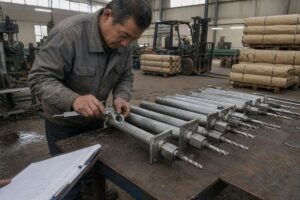
Years of running incoming and outgoing inspections at our Shandong plant have taught me one thing: most defects are predictable, and almost all of them are detectable before installation.
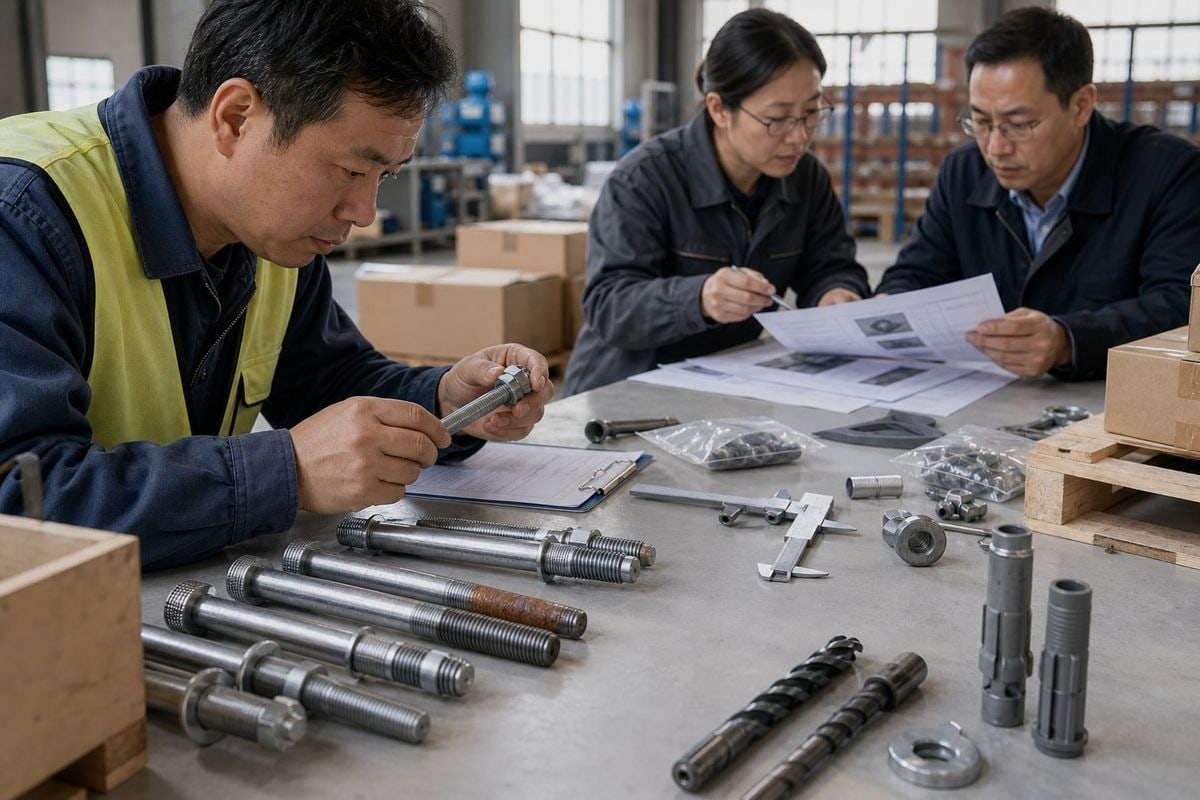
Watch for weak tensile strength, wrong thread dimensions, poor galvanizing or corrosion protection, bent bars, mismatched couplers and nuts, defective drill bits, missing accessories, and certification paperwork that does not match the shipped lot. These are the most common product non-conformity categories in this industry.
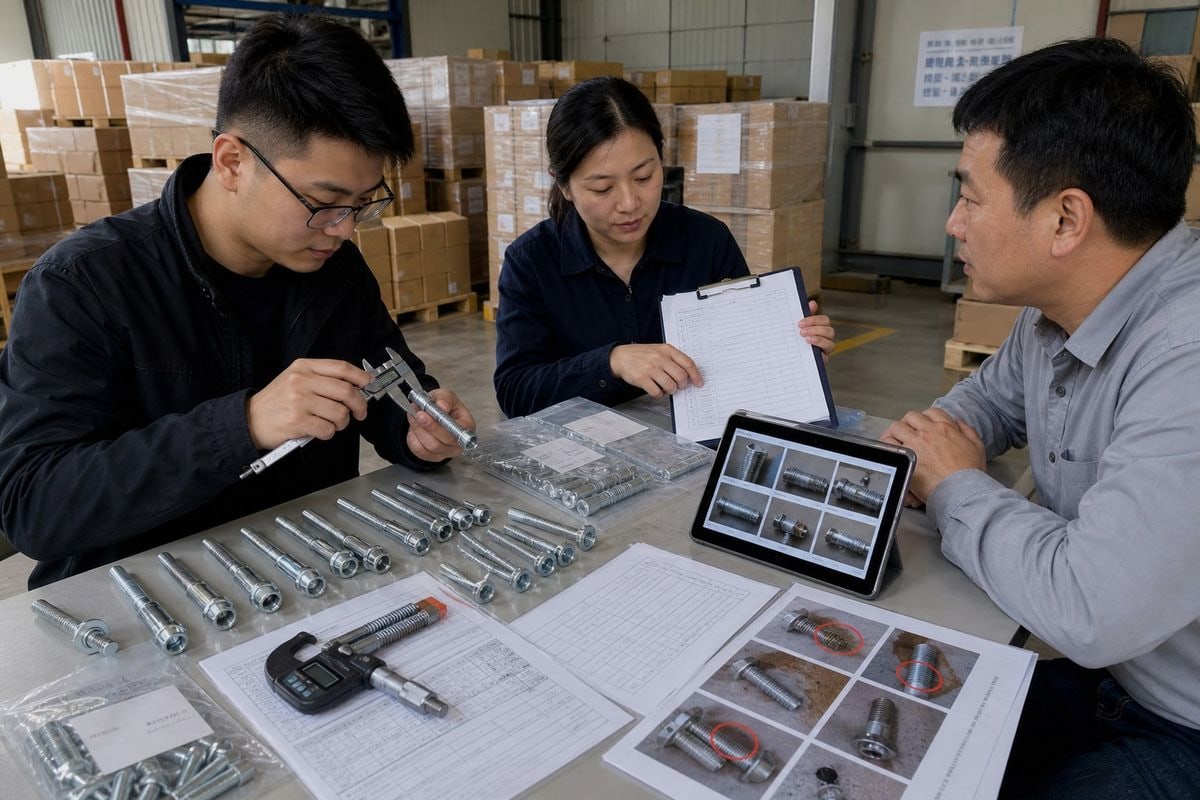
Quality varies widely across Chinese factories. Some plants run full quality control procedures 2 with incoming, in-process, and outgoing inspection. Others cut corners on raw steel to hit a low price. So you need to know exactly what can go wrong before you can protect yourself.
The Main Defect Categories
A self-drilling anchor system is not one product. It is a hollow bar, a drill bit, couplers, nuts, and plates. Each component has its own failure risk. Here is how I would rank them based on the complaints we see across the market.
| Defect Type | What It Looks Like | Risk Level | When You Can Detect It |
|---|---|---|---|
| Weak tensile strength 3 | Bar fails below rated load | Critical | Lab testing before use |
| Thread inconsistency | Coupler binds or strips | High | Receiving inspection |
| Poor corrosion protection 4 | Thin or flaking galvanizing | High | Visual check on arrival |
| Dimensional errors | Wrong diameter, length, wall thickness | High | Measurement on arrival |
| Drill bit defects | Buttons crack or wear early | Medium | Field performance |
| Missing accessories | Short nuts, plates, or bits | Medium | Count on arrival |
| Paperwork mismatch | Certificates do not match the lot | Serious | Document review |
Why Documentation Defects Matter Most
The last item deserves attention. If a supplier sends generic certificates that do not trace back to your batch, you have no baseline for a claim. International fastener standards like ISO 9001 5, ASTM specifications, and GB/T 35056-2018 only protect you when the test reports connect to your actual shipment. Ask for Mill Test Reports for each batch. Check the heat numbers. If the numbers do not match the bundles, raise the issue before the bolts go underground, not after.
How Do I File a Valid Claim with My Chinese Rock Bolt Supplier?
A contractor in Chile once emailed us three angry lines and one blurry photo. We wanted to help, but we could not act on it. That exchange shaped how we now coach every buyer.
File a claim in writing within the contract's notice period. State the PO number, batch numbers, and defect. Cite the exact specification or standard violated. Attach photos, measurements, and test results. Request a specific remedy, such as replacement, credit note, or refund, and set a clear response deadline.

A valid claim is a structured argument, not a complaint. In my experience exporting to Europe, the USA, and South America, the buyers who get fast remedies all follow the same sequence. The buyers who struggle send emotion instead of evidence.
The Five-Step Claim Process
- Notify quickly. Send written notice as soon as you find the defect. Most contracts have a claim window. Late notice weakens your position, even when the defect is real.
- Quarantine the goods. Stop distribution or installation of the affected lot. Keep samples intact. A supplier cannot verify a defect if the evidence is already grouted into a rock face.
- Build the evidence file. Photos, videos, dimensional measurements, and third-party test reports. Tie everything to batch numbers on the packing list.
- State the deviation. Do not say the bolts are "bad." Say the R32 bar tested at a load below the rated capacity in your signed spec sheet, or the coating thickness measured under the agreed minimum.
- Propose the remedy and deadline. Ask for something specific: expedited reshipment, rework, partial refund, or a credit note against the next order. Give a reasonable deadline, usually seven to fourteen days for a first response.
Matching Remedies to Situations
Different problems justify different remedies. Asking for a full refund over a five percent shortage will stall negotiations. Here is a realistic mapping.
| Claim Scenario | Typical Remedy | Negotiation Difficulty |
|---|---|---|
| Short shipment or missing items | Free reshipment or credit note | Easy |
| Visible defects on receipt | Replacement of affected lot | Moderate |
| Failed mechanical testing | Replacement plus testing costs | Moderate to hard |
| Failure after installation | Case-by-case investigation | Hard |
| Falsified certificates | Refund and relationship review | Serious escalation |
For large B2B orders, trade dispute resolution depends on documentation and commercial leverage, not consumer-style return rules. A supplier who wants your next 500-ton order will move fast when your evidence is solid.
What Documentation Do I Need to Support a Quality Claim on Anchor Bolts?
There is a trade-off I weigh on every shipment: more documentation costs time, but a missing paper can cost an entire claim. After twenty years in this business, I always choose the paper.
Support your claim with the purchase order and signed spec sheet, packing list with batch and lot numbers, Mill Test Reports, photos and videos of defects, dimensional measurements, accredited third-party test results, installation records, and your written notice to the supplier with the requested remedy.
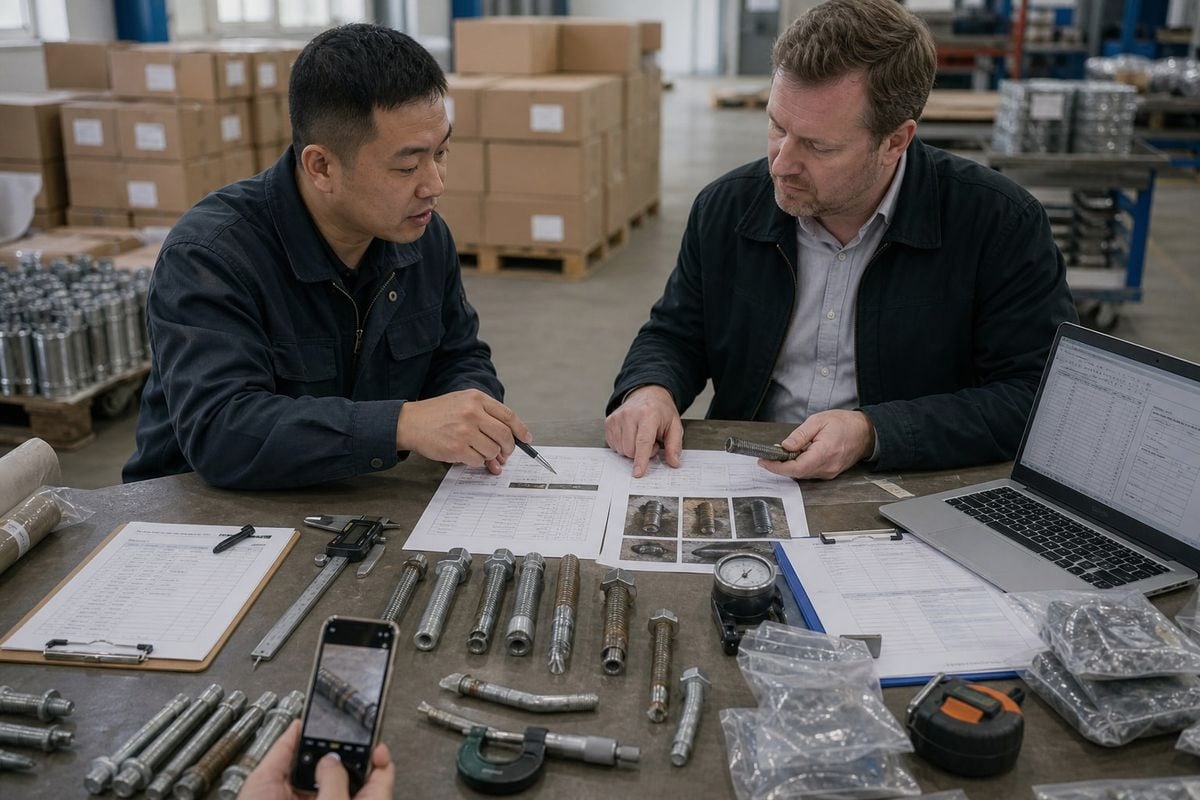
Traceability is the backbone of any claim. If neither side can connect the shipped bolts to raw materials and test results, the dispute becomes a stalemate. Our factory keeps batch records precisely because they protect both parties when questions arise.
The Core Evidence Checklist
- Purchase order and signed specification sheet
- Sales contract with acceptance criteria and claim terms
- Packing list showing batch and lot numbers
- Mill Test Reports verifying steel grade and mechanical properties
- Photos and videos showing defects with batch labels visible
- Dimensional measurements with sample counts and tools used
- Tensile strength testing results from an accredited lab
- Coating thickness readings for corrosion protection checks
- Installation records, drill logs, and grouting data if failure occurred on site
- Written claim notice with remedy request and deadline
Which Documents Prove What
Each document answers a different question in the dispute. Understanding this helps you prioritize when time is short.
| Document | Question It Answers | Who Provides It |
|---|---|---|
| Signed spec sheet | What was ordered? | Both parties |
| Mill Test Report | What steel was used? | Supplier |
| Packing list with lot numbers | Which batch is affected? | Supplier |
| Third-party test report | Does the product fail spec? | Accredited lab |
| Photos with labels visible | What condition did goods arrive in? | Buyer |
| Installation records | Was site procedure correct? | Buyer or contractor |
Why Third-Party Testing Carries the Most Weight
Your own measurements start the conversation. An accredited lab report usually ends it. Labs recognized under CNAS, CMA, or ILAC-MRA frameworks produce results a supplier cannot easily dismiss. When we ship material certifications with our bolts, we expect serious buyers to spot-check them independently. That is not distrust. That is professional procurement, and it makes any later negotiation short and factual.
How Can I Prevent Future Quality Disputes with My Self-Drilling Anchor Bolt Supplier?
A procurement manager from the USA once told me she spends more time preventing claims than filing them. Her orders with us have run smoothly for years, and her method is worth copying.
Prevent disputes by vetting suppliers before ordering, writing measurable acceptance criteria into the contract, requiring batch-level Mill Test Reports and third-party pre-shipment inspection, running a receiving inspection on every delivery, retaining samples, and building traceability requirements into long-term supply agreements.

Prevention is cheaper than any claim. A rejected container costs weeks. A site failure costs far more. So shift your effort upstream, where control is still cheap.
Vet Before You Buy
Supplier vetting China style means going beyond the website. Check business licenses and export history. Ask for the ISO 9001 certificate and verify its scope. Request references from projects in your region. Ask how the factory structures its quality control procedures: incoming raw material inspection, in-process checks, and final outgoing inspection should all exist as documented steps. A factory that cannot describe its process clearly probably does not run one. If the order is large, audit the plant in person or hire a local inspection firm. When buyers visit our production line in Shandong, we treat it as a sign of seriousness, not suspicion.
Separate Product Defects from Installation Errors Early
Many field failures are not manufacturing problems. Misaligned drilling, wrong hole depth, debris left in the hole, inconsistent mortar mix, and unstable grouting pressure all cause anchor bolt failure modes that mimic product defects. Poor hole cleaning alone can ruin grout bond strength 6 and make a compliant bolt pull out under load. So agree with your supplier, in writing, on how post-installation failures will be investigated. Keep drill logs and grouting records on every project. If the bolts passed incoming inspection and the failure matches poor site procedure, the remedy is a construction correction, not a supplier claim. That clarity protects the relationship on both sides.
Build Prevention into the Contract
Write acceptance criteria as numbers, not adjectives. Specify the standard, the tolerance, the test method, and the sampling plan. Require multi-layered packaging for sea freight to prevent transit corrosion. For strategic volumes, consider performance-linked terms, where a portion of payment or future orders depends on verified in-field performance. Some buyers now explore digital traceability and even blockchain-based records from raw material to installation. You do not need that level on day one. You do need batch numbers, test reports, and retained samples on every single order.
Conclusion
Claims succeed on proof, not anger. Define specs, inspect arrivals, trace every batch, and document deviations. Do that, and quality issues with self-drilling anchor bolts become manageable, not catastrophic.
Footnotes
1. Authoritative source for technical standards for materials and testing. ↩︎
2. Explains the systematic process of reviewing production factors for quality. ↩︎
3. Defines a key mechanical property for material performance and testing. ↩︎
4. Provides a general overview of corrosion and methods of protection. ↩︎
5. Official source for the international quality management system standard. ↩︎
6. Authoritative research article on the bond strength of grouted reinforcing bars from the American Concrete Institute. ↩︎