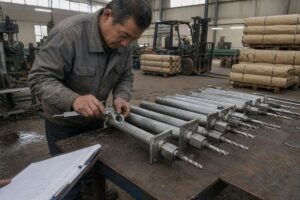
Are you struggling with collapsing boreholes or slow installation times? Unstable ground can ruin your schedule and budget. Use the right anchoring system to keep your project moving safely and fast.
*The main difference is the installation process. Self-drilling anchor (SDA) bolts act as the drill string, borehole support, and grout pipe all at once. Conventional rock bolts require a pre-drilled hole, which often collapses in loose soil, making SDAs much faster and more reliable in difficult ground.
I have seen many projects stall because the ground simply would not hold a hole open. It is frustrating to watch a crew drill a hole only to have it fill with sand or gravel the moment they pull the steel out. You need a solution that works the first time, every time. Let me break down why the choice between these two systems changes everything for your site.
Why Does the Installation Process Matter So Much?
Do you waste hours trying to clean out collapsed holes? Traditional drilling often fails in fractured rock or loose soil. This leads to lost time, higher labor costs, and massive frustration for your entire field crew.
SDA bolts combine drilling, placing, and grouting into a single continuous step. You do not need to remove the drill rod or use temporary casing. This eliminated the risk of hole collapse and allows for much faster installation compared to the multi-step process required for conventional bolts.
In my experience, the "drill-drop-grout" method of conventional bolts works fine in solid, competent rock. But how often do we get perfect rock? When I work on slope stabilization or old tunnels, the ground is usually a mess. Conventional bolts require you to drill the hole, pull the rod, and then try to slide the bolt in. If the ground is loose, the hole closes up instantly. You end up drilling the same hole three times. With an SDA bolt, the hollow bar is the drill rod. You leave it in the ground.
This change in workflow isn't just about speed; it is about site safety. Less time spent fiddling with collapsing holes means less exposure for your workers. We use a sacrificial drill bit at the tip of the hollow bar. You choose the bit based on the ground—clay, sand, or hard rock. Once you reach the depth you need, you pump grout through the center of the bar. The grout comes out the bit and fills the space from the bottom up. This ensures a solid bond every single time.
| Feature | Conventional Rock Bolt | SDA Self-Drilling Bolt |
|---|---|---|
| Drilling Tool | Separate Drill Rod | The Bolt Itself (Hollow Bar) |
| Hole Support | Needs Casing in Loose Soil | Self-Supporting |
| Steps | Drill, Remove Rod, Insert Bolt, Grout | Drill and Grout Simultaneously |
| Best Use Case | Hard, Stable Rock | Loose Soil, Fractured Rock, Silt |
| Equipment | Standard Drill Rig | Grout Pump + Rotary-Percussive Rig |
Is the Load Capacity Reliable in Weak Ground?
Are you worried that a faster system might sacrifice strength? In geotechnical work, a bolt is only as good as its bond to the earth. If the grout does not fill the voids, the anchor will fail your pull test.
SDA bolts provide superior bond strength because the grout is injected under pressure through the hollow core. This creates a "root-like" structure in the surrounding soil. The rough thread on the outside of the bar further increases the mechanical interlock with the grout and the ground.
I often get asked if these hollow bars can handle the same loads as solid rebar. The answer is yes, and often they perform better in the field. When we pump grout through the SDA bar, we do it while the bar is still in place. The pressure forces the grout into the cracks and pores of the rock. This creates a much larger "effective diameter" than a standard hole.
Think about it like a tree root. A smooth pole is easy to pull out of the dirt. A root with many small branches is almost impossible to move. The pressurized grouting of an SDA system mimics those branches. I have performed many pull-out tests where the SDA out-performed a larger diameter conventional bolt simply because the grout coverage was more complete.
Also, the threads on our SDA bars run the full length. This means you can cut the bar at any point and still fit a nut or a coupler on it. If you hit an obstruction and need to stop early, you don't waste the bolt. You just cut it, add the plate, and move on. This flexibility is a lifesaver when the site conditions change suddenly. We offer different grades of steel to match your specific load requirements, ensuring your project stays within safety limits without overspending on materials.
| Component | Function in SDA System | Benefit for Michael |
|---|---|---|
| Hollow Bar | Carries load and acts as grout pipe | Dual-purpose saves material costs |
| Sacrificial Bit | Cuts through specific ground types | Faster penetration in tough soil |
| Coupler | Joins bar sections for deep anchoring | Allows for long anchors in tight spaces |
| Full Thread | Provides continuous bond surface | Easy to cut and fit hardware anywhere |
Can You Save Money by Using More Expensive Bolts?
Does the higher price of SDA bars make you hesitate? It is easy to look at the material cost and choose the cheaper conventional bolt. But the "cheap" option often leads to hidden costs that blow your budget.
Yes, SDA bolts save money by reducing labor hours and equipment rental time. Because you install them much faster and do not need expensive casing equipment, the total "installed cost" per meter is often lower than conventional bolts in difficult ground conditions.
I have looked at the numbers on dozens of sites. Let's say a conventional bolt costs $50 and an SDA bolt costs $80. On paper, the conventional bolt looks like the winner. But then you get to the site. The conventional bolt takes two hours to install because the hole keeps collapsing. You need a specialized casing rig that rents for thousands a day. Your crew is standing around waiting.
Now look at the SDA bolt. It goes in the ground in 20 minutes. You use a standard rotary-percussive rig. You don't need the casing. Your labor cost drops by 70%. When you add up the hours, the SDA bolt is actually the more profitable choice. I tell my clients to focus on the cost of the finished, installed anchor, not just the steel.
We also see huge savings in tight spaces. If you are working in a basement or a small tunnel, you cannot fit a long drill string. With SDA bolts, we use short segments and couplers. You drill a 2-meter section, couple another 2-meter section, and keep going. You can reach 20 or 30 meters deep in a room with only 3 meters of headroom. This capability opens up projects that would be impossible with conventional solid bars. Efficiency is the key to winning bids and staying profitable in this industry.
| Cost Factor | Conventional Bolt | SDA Bolt |
|---|---|---|
| Material Cost | Lower | Higher |
| Installation Time | High (Multi-step) | Low (Single-step) |
| Equipment Needs | High (Casing, specialized rigs) | Low (Standard rigs) |
| Labor Cost | High (More man-hours) | Low (Fast completion) |
| Total Project Cost | Higher in bad ground | Lower in bad ground |
Conclusion
Choosing between SDA bolts and conventional bolts depends on your ground conditions. If you have solid rock, conventional bolts are a fine choice. But for most infrastructure projects with unpredictable soil, SDA bolts are the superior tool. They save time, reduce labor costs, and provide a reliable bond where other systems fail. At SDA Rock Bolt, we provide the high-quality hollow bars and bits you need to get the job done right. Visit our website at https://sdarockbolt.com/ to see our full range of products and find the perfect match for your next project.