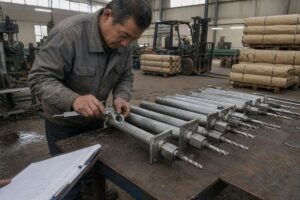
Sourcing self-drilling anchor bolts from China can save you 30–50% on material costs. But one failed compliance check can shut down an entire US project.
When importing self-drilling anchor bolts from China for US projects, buyers must verify compliance with ASTM standards (such as A1034 and F1554) for material properties, obtain ICC-ES evaluation reports for building code approval, demand complete mill test reports, and confirm corrosion protection meets US durability requirements through third-party testing.
Every year, our team fields dozens of questions from US contractors and distributors about exactly which certifications matter and which ones are just noise. The truth is, the compliance landscape is layered. You need to understand material standards, building code evaluations, testing documentation, and corrosion specifications — each one serving a different gatekeeper. Let me walk you through them one by one.
Which ASTM Standards Should I Prioritize When Evaluating Self-Drilling Anchor Bolts From Chinese Suppliers?
When we ship self-drilling anchor bolts to the US, the first question every serious buyer asks is about ASTM compliance. Without it, your bolts will not pass inspection on any regulated job site.
US buyers should prioritize ASTM A1034 for mechanical testing of ground anchors, ASTM F1554 for anchor bolt grades and chemical composition, and ASTM D7558 for load capacity and installation torque verification. These three standards cover the core performance requirements for geotechnical and structural applications.
Understanding the Key ASTM Standards
ASTM standards are the backbone of US construction material compliance. For self-drilling anchor bolts, three standards matter most.
ASTM A1034/A1034M covers the testing of metallic anchors in concrete and masonry. It specifies how to measure tensile strength, yield strength, and elongation. When our quality control team runs tests before shipment, we follow this protocol so buyers can present results directly to US inspectors.
ASTM F1554 is the standard specification for anchor bolts used in concrete foundations. It defines three grades based on minimum yield strength:
| ASTM F1554 Grade | Minimum Yield Strength (ksi) | Typical Application |
|---|---|---|
| Grade 36 | 36 | Light structural anchoring |
| Grade 55 | 55 | Medium-load foundations, sign poles |
| Grade 105 | 105 | High-load seismic and bridge anchoring |
This standard also specifies chemical composition limits for carbon, manganese, phosphorus, and sulfur. If your supplier cannot provide a chemical analysis matching these limits, that is a red flag.
ASTM D7558 focuses on the load capacity and installation torque of soil nails and ground anchors. This is critical for self-drilling anchor bolts used in slope stabilization, tunneling, and retaining wall projects. It verifies that the bolt can handle specified loads under real-world geotechnical conditions.
How Chinese Standards Differ From ASTM
Chinese manufacturers typically produce under GB and JC national standards. For example, JGJ 94-94 covers anchor selection and prestress, while MT/T 992-2012 addresses mining-specific requirements. These standards are not bad — they just do not map directly to ASTM requirements.
| Aspect | Chinese GB/JC Standards | US ASTM Standards |
|---|---|---|
| Steel grade classification | GB/T 700, GB/T 1591 | ASTM A615, A706, F1554 |
| Tensile testing method | GB/T 228.1 | ASTM A370, A1034 |
| Load capacity testing | JGJ 94-94 | ASTM D7558 |
| Thread specification | Metric (M series) | Metric or Imperial |
| Certification body | CNAS, CMA | A2LA, NVLAP |
The gap between these two systems is where compliance problems hide. Our engineering team has learned to run dual-standard testing — once under Chinese protocols for domestic records, and again under ASTM protocols for US-bound shipments. This costs more, but it eliminates surprises at the port or on the job site.
What About AASHTO M 314?
For anchor bolts used in highway signs, street lighting, and traffic signal supports, AASHTO M 314 applies. This standard is largely identical to ASTM F1554 but is specifically referenced by state DOTs. If your project involves any federally funded highway infrastructure, make sure your supplier knows this standard by name.
Independent test data shows that failure rates for uncertified imports run between 5–10%, compared to under 1% for ASTM-compliant products. The cost of ASTM lab testing is roughly $5,000 per batch. That is a small price compared to a project shutdown or a liability claim.
How Can I Ensure My Chinese-Sourced Anchor Bolts Meet the ICC-ES Requirements for US Construction Projects?
Our export team has worked with several US distributors who lost months of project time because they did not understand ICC-ES requirements before placing orders. This is a mistake you can avoid.
To meet ICC-ES requirements, buyers should source from manufacturers who can provide products tested to AC358 or relevant acceptance criteria, obtain an ICC-ES Evaluation Service Report (ESR) for the specific product, and ensure all test data comes from ISO 17025-accredited laboratories recognized in the United States.
What Is ICC-ES and Why Does It Matter?
ICC-ES stands for International Code Council Evaluation Service. It is the body that evaluates building products to confirm they comply with US building codes — primarily the International Building Code (IBC) and International Residential Code (IRC).
An ICC-ES Evaluation Service Report (ESR) is not a "nice to have." On many US job sites, the building inspector will ask for it. Without an ESR, your anchor bolts may be rejected even if they are perfectly good products.
The ESR covers:
- Load capacity data
- Installation requirements
- Material specifications
- Corrosion protection details
- Conditions of use
The Path to Getting an ESR for Chinese-Made Bolts
Getting an ESR for a product manufactured in China is possible but requires planning. Here is the typical process:
- Identify the acceptance criteria. For anchor bolts, AC358 (Acceptance Criteria for Helical Foundation Systems and Devices) or AC193 (Mechanical Anchors in Concrete Elements) may apply depending on the application.
- Conduct testing at an accredited lab. The lab must hold ISO 17025 accreditation and be recognized by ICC-ES. Tests must follow ASTM protocols.
- Submit the application. The manufacturer or the US importer submits the test data, product drawings, and quality documentation to ICC-ES.
- Factory inspection. ICC-ES may require an on-site audit of the manufacturing facility in China.
- Report issuance. If everything passes, ICC-ES issues the ESR, which is publicly available and searchable online.
When we prepare shipments for US projects that require ICC-ES compliance, we coordinate with the buyer's engineering team early. We provide all raw test data, dimensional drawings, and quality control records so the application process moves faster.
Buy America Act Considerations
For federally funded infrastructure projects, the Buy America Act (BAA) and the Build America, Buy America Act (BABA) add another layer. These laws require that iron, steel, and manufactured products be produced in the United States from US-originating steel.
This means Chinese-made self-drilling anchor bolts are generally not eligible for federally funded projects unless a waiver is granted. Waivers are sometimes available when domestic supply is insufficient or when the cost difference exceeds 25%. But do not count on a waiver — check with the project owner before quoting.
For privately funded projects or state-funded projects without BAA clauses, Chinese-sourced bolts with proper ICC-ES documentation are fully acceptable.
Cost of ICC-ES Compliance
| Cost Item | Estimated Range (USD) |
|---|---|
| Lab testing (per acceptance criteria) | $8,000 – $25,000 |
| ICC-ES application fee | $5,000 – $15,000 |
| Factory audit (if required) | $3,000 – $8,000 |
| Annual renewal fee | $2,000 – $5,000 |
| Total first-year cost | $18,000 – $53,000 |
These numbers look high. But spread across a large order — say, 500 tons of R51 self-drilling anchor bolts — the per-unit cost is minimal. And the ESR opens doors to projects that would otherwise be closed to you.
What Specific Material Test Reports Should I Demand From My Supplier to Guarantee Compliance With US Safety Codes?
In our 20+ years of exporting self-drilling anchor bolts, the single biggest source of disputes has been incomplete or inaccurate test documentation. Buyers who skip this step pay for it later.
Buyers should demand mill test reports (MTRs) with full chemical analysis and mechanical properties, third-party tensile and yield strength test certificates from ISO 17025 labs, dimensional inspection reports, and traceability documentation linking each batch to its raw material source and heat number.
The Mill Test Report (MTR) Is Non-Negotiable
A Mill Test Report — also called a Certified Material Test Report (CMTR) — is the foundational document. It certifies the chemical composition and mechanical properties of the steel used in your anchor bolts.
Every MTR should include:
- Heat number — links the finished product back to the specific steel melt
- Chemical composition — carbon, manganese, phosphorus, sulfur, silicon, and any alloying elements
- Mechanical properties — tensile strength, yield strength, elongation, and reduction of area
- Steel grade designation — per ASTM or equivalent standard
- Test method reference — typically ASTM A370
When our production team finishes a batch, we generate MTRs that reference both the Chinese GB standard and the equivalent ASTM standard. This dual-reference approach helps US buyers cross-check values without needing a conversion table.
Beyond the MTR: What Else to Request
A good MTR is necessary but not sufficient. Here is the full documentation package you should demand:
Third-party test certificates. Do not rely solely on the manufacturer's in-house lab. Request test results from an independent, ISO 17025-accredited laboratory. In China, labs like SGS, TÜV, and Bureau Veritas operate testing facilities that US inspectors trust.
Dimensional inspection reports. Self-drilling anchor bolts have tight tolerances on outer diameter, inner diameter, thread pitch, and wall thickness. A dimensional report confirms the bolts match the specified geometry.
Traceability documentation. This is increasingly important. US Customs and Border Protection (CBP) may request proof of material origin. A complete traceability chain — from raw steel supplier to finished bolt — protects you against anti-dumping duty challenges and supply chain fraud.
Red Flags in Test Documentation
Watch for these warning signs:
- Generic MTRs that do not reference a specific heat number or batch
- Round numbers on mechanical properties (real test data has decimal points)
- Missing test method references — if the report does not say "tested per ASTM A370," ask why
- No lab accreditation number on third-party certificates
- Photocopied signatures or low-resolution scans that look altered
Our quality assurance team has caught these issues in competitor products that buyers brought to us for comparison. In one case, a buyer discovered that the MTR provided by another supplier showed identical values across five different batches — a statistical impossibility that indicated fabricated data.
MSHA Requirements for Mining Applications
If your self-drilling anchor bolts are destined for underground mining, MSHA 30 CFR Part 57 applies. This regulation mandates specific testing and safety protocols for ground support systems. MSHA-compliant documentation includes:
- Pull-out test results conducted under site-specific conditions
- Installation torque verification records
- Proof of compliance with the mine's approved ground control plan
MSHA data from 2023–2025 shows 15% fewer ground support incidents in operations using fully compliant anchor systems. That statistic alone justifies the extra documentation effort.
How Do I Verify That the Corrosion Protection on My Imported Anchor Bolts Meets US Environmental and Durability Standards?
When we design corrosion protection systems for our self-drilling anchor bolts, we always ask the buyer one question first: what is the service environment? The answer changes everything.
To verify corrosion protection compliance, buyers should confirm the coating meets ASTM A153 (hot-dip galvanizing) or ASTM B633 (zinc electroplating), request salt spray test results per ASTM B117 with minimum hours specified, and match the protection level to the project's exposure category as defined by the engineer of record.
Why Corrosion Protection Is Critical for Self-Drilling Anchor Bolts
Self-drilling anchor bolts are permanent installations. Once grouted into the ground, they cannot be inspected or replaced without enormous cost. If the corrosion protection fails, the bolt loses cross-sectional area, tensile capacity drops, and the entire anchored structure is at risk.
In the US, environments vary dramatically. Coastal projects in Florida face salt spray. Mining operations in Nevada deal with acidic groundwater. Highway projects in the Northeast endure de-icing salt exposure. Each environment demands a different level of protection.
Common Corrosion Protection Methods
| Protection Method | Applicable ASTM Standard | Typical Coating Thickness | Best For |
|---|---|---|---|
| Hot-dip galvanizing | ASTM A153 | 85–100 µm | Moderate to aggressive environments |
| Zinc electroplating | ASTM B633 | 8–25 µm | Mild indoor or temporary applications |
| Epoxy coating | ASTM A775 | 175–300 µm | Highly aggressive chemical environments |
| Duplex system (galvanizing + epoxy) | Combined standards | 250–400 µm | Extreme marine or acidic soil conditions |
| Stainless steel (no coating) | ASTM A276 / A580 | N/A | Permanent marine or high-chloride environments |
At our factory, hot-dip galvanizing per ASTM A153 is the most common request from US buyers. It provides a good balance of cost and durability. For projects in harsh environments, we offer duplex systems or can manufacture bolts from stainless steel alloys.
Salt Spray Testing: The Standard Benchmark
ASTM B117 is the standard for salt spray (fog) testing. This accelerated corrosion test exposes coated samples to a continuous salt fog environment and measures how long the coating resists white rust (zinc corrosion) and red rust (base metal corrosion).
For hot-dip galvanized self-drilling anchor bolts, a minimum of 500 hours to white rust and 1,000 hours to red rust is a reasonable benchmark. Some US project specifications require 1,500 hours or more for critical infrastructure.
When you request salt spray test results from your supplier, check these details:
- Test duration — how many hours was the sample exposed?
- Rust type observed — white rust is acceptable early; red rust indicates coating failure
- Sample preparation — was the sample a production piece or a specially prepared coupon?
- Lab accreditation — the testing lab should hold ISO 17025 accreditation
Environmental Product Declarations (EPDs)
A growing trend in US construction is the demand for Environmental Product Declarations. EPDs quantify the environmental impact of a product across its lifecycle — from raw material extraction through manufacturing, use, and disposal.
While EPDs are not yet mandatory for anchor bolts in most US jurisdictions, they earn points under green building rating systems like LEED v4.1. Forward-thinking buyers are already asking us about EPD availability. We are working with third-party verifiers to develop EPDs for our main product lines.
Matching Protection to Project Requirements
The engineer of record (EOR) on a US project will specify the required corrosion protection level. This specification is typically based on:
- Soil resistivity measurements
- pH levels of groundwater
- Chloride concentration
- Expected service life (usually 75–100 years for permanent anchors)
If your supplier does not ask about these factors, they are not thinking about your project's long-term performance. Our technical team reviews project specifications before recommending a corrosion protection system. This proactive approach has helped us build long-term relationships with US distributors who value reliability over the lowest price.
The US geotechnical anchor market exceeds $1.2 billion annually. Self-drilling types now capture about 25% of that market, driven by their 3-in-1 efficiency — drill, grout, and anchor in one step, saving up to 50% installation time compared to traditional methods. But that efficiency means nothing if the bolt corrodes and fails within a decade. Proper corrosion protection is what separates a cost-effective solution from a liability.
Conclusion
Sourcing self-drilling anchor bolts from China for US projects is viable — but only with proper ASTM testing, ICC-ES documentation, complete material traceability, and verified corrosion protection matched to your project environment.