
Every year, our export team fields dozens of urgent calls from US contractors who discover—too late—that their imported anchor bolts 1 lack the right certifications for American job sites. The project stalls, costs spike, and relationships fracture AWS D1.1 structural welding code 2. It is a painful problem, and it is entirely preventable.
When sourcing self-drilling anchor bolts from China for US projects, you must ensure compliance with ASTM material standards (A615, A1034, F1554), obtain ICC-ES evaluation reports for building code acceptance, meet Buy America provisions on federally funded work, and handle HTS tariff classification to avoid anti-dumping duties.
This guide breaks down every standard, certification, and import step you need PTI DC45.1 standard 3. We will walk through ASTM requirements, material test report verification, building code certifications, and customs documentation so your next shipment clears every hurdle.
Which ASTM standards must my Chinese supplier follow for my self-drilling anchor bolt order?
In our experience shipping over 5,000 tons of self-drilling anchor systems to US job sites, ASTM compliance is the single biggest question buyers ask—and the area where mistakes cost the most.
Your Chinese supplier must follow ASTM A615/A615M for steel reinforcement properties, ASTM A1034 for self-drilling anchor tensile and shear performance, ASTM F1554 for general anchor bolt grades and coatings, and ASTM A153 for hot-dip galvanizing thickness on exposed anchors.
Understanding the Core ASTM Standards
Not all ASTM standards serve the same purpose. Some govern the raw steel. Others govern the finished product. And a few cover the protective coatings. Here is how they fit together for self-drilling anchor bolts (SDAs).
ASTM A615/A615M is the foundation. It specifies chemical composition, yield strength, tensile strength, and elongation for deformed steel bars. Most SDA hollow bars fall under Grade 60 (60 ksi yield) or Grade 75. Your supplier's mill must control carbon, manganese, phosphorus, and sulfur within tight limits. If these numbers drift, the bar can become brittle or fail under cyclic loading in fractured rock.
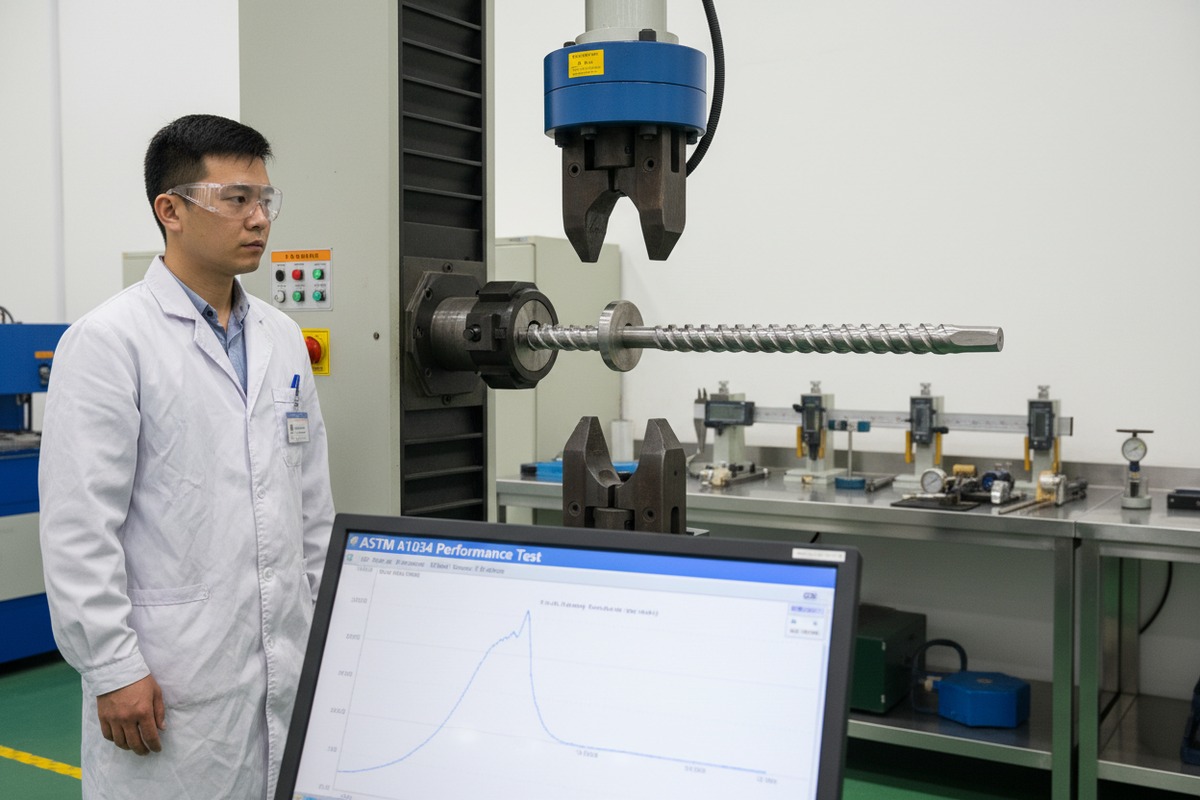
ASTM A1034 goes further. It is specific to self-drilling anchors used in concrete and masonry. It requires proof of minimum yield load, ultimate load, and grout bond performance. For example, an R32 hollow bar must demonstrate yield loads near 200–400 kN depending on the grout and ground conditions. This standard also covers installation methods, so your supplier must understand how the anchor will actually be drilled and grouted on site.
ASTM F1554 applies to anchor bolts broadly. It defines three grades—36, 55, and 105—based on yield strength. For SDAs, Grade 36 and 55 are most common. This standard also requires documentation of galvanized or epoxy coatings for corrosion protection.
ASTM Coating and Welding Standards
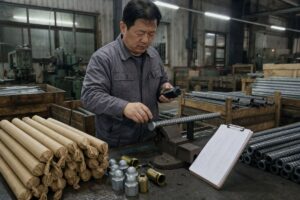
Corrosion kills anchor bolts slowly and invisibly. ASTM A153 specifies minimum zinc coating weight 4 for hot-dip galvanized hardware. If your SDAs will sit in acidic soil or coastal environments, this standard is non-negotiable. We test coating thickness on every production batch using magnetic thickness gauges to ensure compliance before shipping.
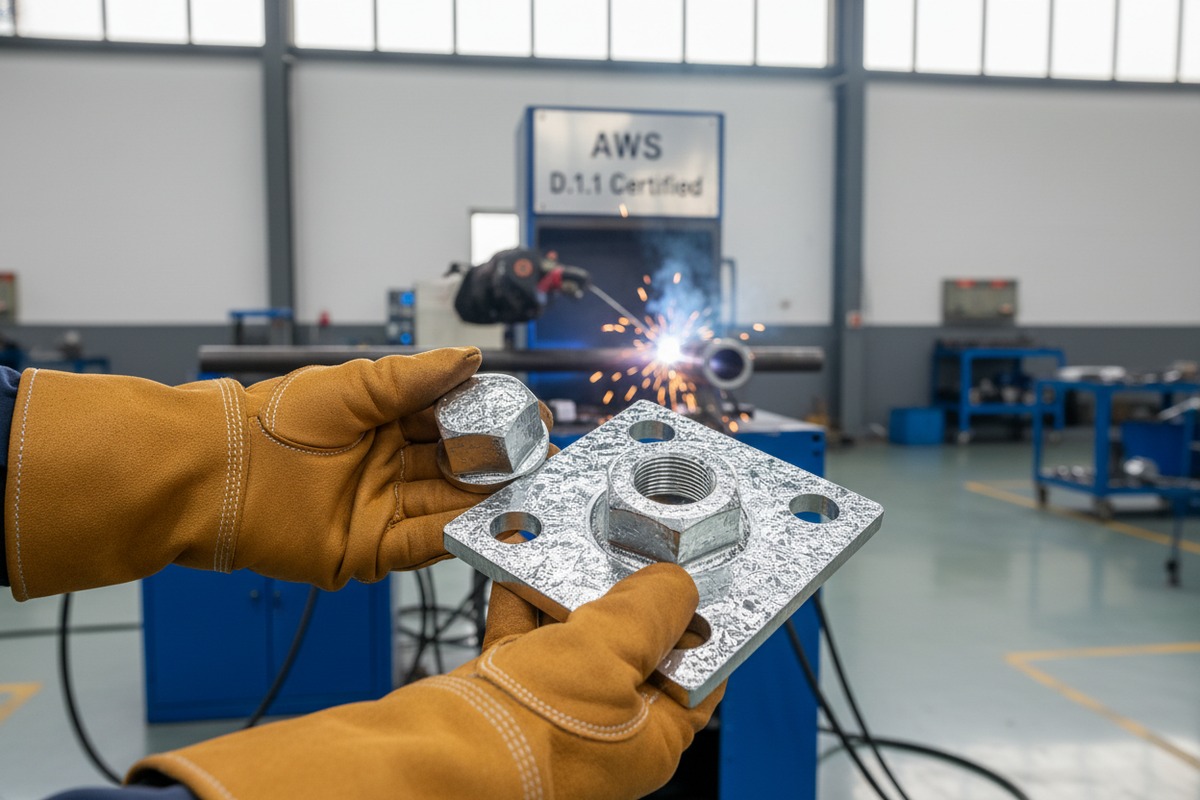
If your project uses couplers to join hollow bar sections, the welds must meet AWS D1.1 structural welding code 5. Poor coupler welds are a leading cause of anchor failure during pullout testing.
Quick Reference: Key ASTM Standards for Self-Drilling Anchor Bolts
| ASTM Standard | Scope | Key Requirements | Typical SDA Application |
|---|---|---|---|
| ASTM A615/A615M | Steel reinforcement bars | Yield strength (Grade 60: 60 ksi), chemical composition, elongation ≥ 9% | Hollow bar raw material |
| ASTM A1034 | Self-drilling anchors for concrete/masonry | Tensile capacity, shear strength, grout bond, installation method | Finished SDA system testing |
| ASTM F1554 | Anchor bolts (general) | Grade 36/55/105 yield, coating requirements | Anchor bolt classification |
| ASTM A153 | Hot-dip galvanizing | Minimum zinc coating weight (oz/ft²) | Outdoor and corrosive soil exposure |
| ASTM B117 | Salt spray testing | Corrosion resistance duration (hours) | Coastal or high-pH environments |
| AWS D1.1 | Structural welding | Weld quality, inspection, procedure qualification | Coupler and plate welding |
What Happens When Standards Are Missing
We have seen US contractors reject entire containers because the supplier provided only an ISO 10208 thread profile certificate but no ASTM-compliant mill test report. The thread profile looked correct. The steel chemistry was unknown. The project engineer refused to accept the material, and the contractor lost three weeks waiting for replacements. Always confirm ASTM compliance before production begins—not after the container is on the water.
How can I verify that the material test reports meet my US project quality requirements?
Our quality control team reviews hundreds of Material Test Reports every month, and the truth is that not all MTRs are created equal. Some look professional but lack critical data fields that US engineers require.
To verify MTRs for US projects, confirm that each report includes the heat number for traceability, full chemical analysis, tensile and yield strength values per ASTM specs, elongation percentage, and that the results are validated by an independent ISO 17025-accredited US laboratory—not solely by the Chinese mill.
What a Complete MTR Must Contain
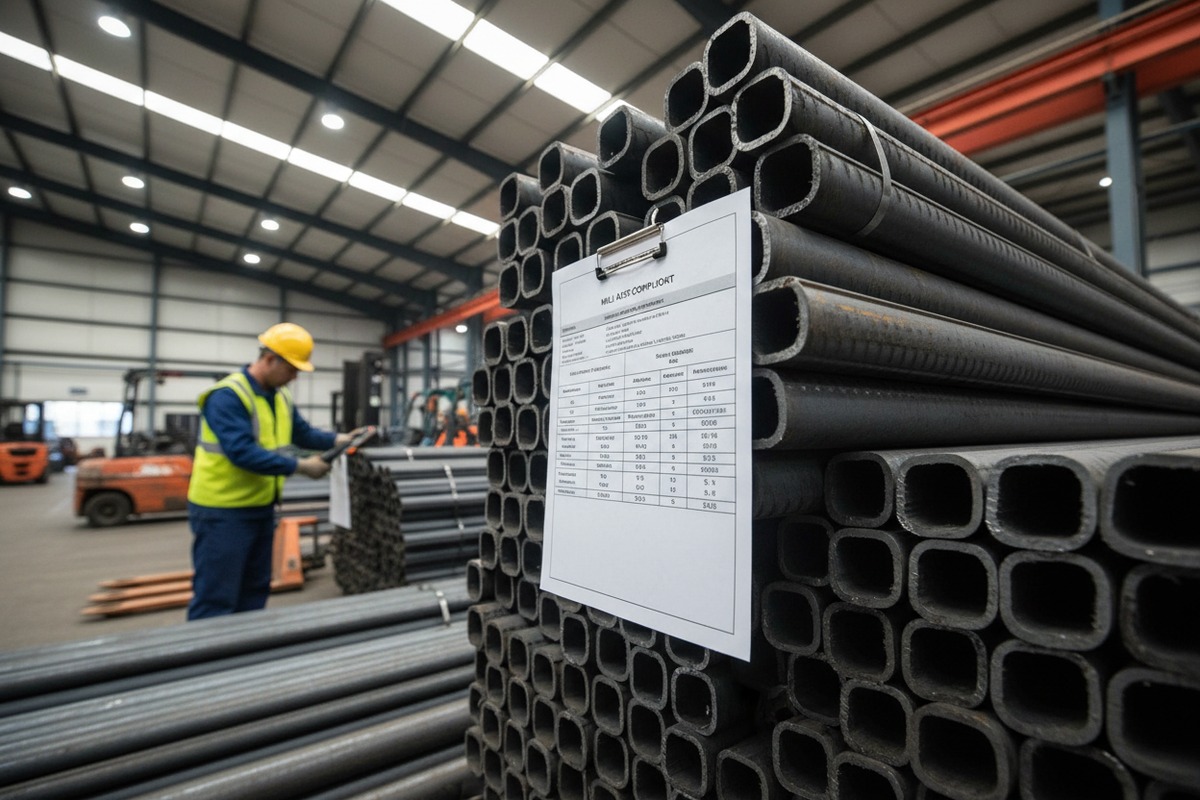
A Material Test Report—also called a Mill Test Certificate (MTC)—is your paper trail. It connects a specific batch of steel to verified mechanical and chemical properties. For US project acceptance, the MTR must include:
- Heat number: This traces the steel back to the exact furnace melt. Without it, there is no traceability.
- Chemical analysis: Carbon, manganese, phosphorus, sulfur, silicon, and any alloying elements. These must fall within ASTM A615 or A1034 limits.
- Mechanical properties: Yield strength, ultimate tensile strength, and elongation. For Grade 60 rebar, yield must meet or exceed 60 ksi and elongation must be at least 9%.
- Test specimen details: Bar diameter, gauge length, and test method (typically ASTM E8 for tensile testing).
- Manufacturer identification: Mill name, location, and certification number.
When we produce SDA hollow bars at our Shandong facility, each MTR is generated per heat number. We stamp the heat number directly onto the bars so the receiving contractor can match steel to paperwork on site.
Why Third-Party Testing Is Essential
Here is the hard truth: some MTRs from overseas mills contain inflated or fabricated numbers. US project engineers know this. That is why most specifications now require independent third-party verification at an ISO 17025-accredited laboratory 6 inside the United States.
The process works like this. You receive a shipment. You pull random samples from multiple bundles. You send those samples to a lab such as Intertek, Element Materials Technology, or a university testing facility. The lab runs tensile tests, chemical analysis, and coating thickness checks. If the results match the MTR within acceptable tolerances, the material is approved.
This step typically costs $3,000–$5,000 per container, depending on the number of samples and tests. It sounds expensive, but it is far cheaper than discovering non-compliant steel after it is grouted into a slope.
MTR Verification Checklist
| Verification Step | What to Check | Acceptable Source |
|---|---|---|
| Heat number traceability | Unique heat number on MTR matches physical stamp on bars | Chinese mill + on-site inspection |
| Chemical composition | C, Mn, P, S within ASTM A615 limits | Mill MTR + US third-party lab |
| Yield strength | ≥ 60 ksi for Grade 60; ≥ 75 ksi for Grade 75 | Mill MTR + US third-party lab |
| Ultimate tensile strength | ≥ 90 ksi for Grade 60 | Mill MTR + US third-party lab |
| Elongation | ≥ 9% in 8-inch gauge (Grade 60) | Mill MTR + US third-party lab |
| Coating thickness | Per ASTM A153 for galvanizing | Magnetic gauge on-site + lab |
| Test method reference | ASTM E8 for tensile testing | Lab report header |
Common Red Flags in MTRs
Watch for these problems. An MTR that lists identical mechanical properties across multiple heat numbers is suspicious—real steel varies slightly from batch to batch. An MTR without a phosphorus or sulfur reading is incomplete. And an MTR that references EN 10080 instead of ASTM may indicate the supplier is substituting a European standard without confirming ASTM equivalence. Dual compliance is possible, but it must be explicitly documented.
We encourage every US buyer to request a sample MTR before placing the order. Review it with your project engineer. If anything looks off, ask questions before production starts.
What certifications do I need to ensure my imported bolts are compliant with US building codes?
When our team first helped a US distributor navigate the ICC-ES evaluation process in 2019, we learned firsthand how different the certification landscape is compared to European CE marking. The US system demands product-specific evaluation reports, not just factory certifications.
To comply with US building codes (IBC/IRC), imported self-drilling anchor bolts need an ICC-ES Evaluation Report under Acceptance Criteria AC437 or AC369, AASHTO M31/M322 certification for transportation projects, and in some states like California, additional seismic qualification testing per ASCE 7 provisions.
ICC-ES Evaluation Reports: The Gateway to Code Acceptance
The International Code Council Evaluation Service (ICC-ES) is the most widely recognized path to proving your anchor bolt system meets the International Building Code (IBC) 7. Building officials across the US accept ICC-ES Evaluation Service Reports (ESRs) as evidence of code compliance.
For self-drilling anchors, the relevant acceptance criteria are AC437 (post-installed adhesive and mechanical anchors) and AC369 (proprietary anchors in concrete). The evaluation process involves:
- Submitting product drawings, specifications, and installation instructions to ICC-ES.
- Providing test data from an ICC-ES recognized laboratory. The tests cover tensile capacity, shear capacity, combined loading, sustained load, and seismic qualification where required.
- ICC-ES engineers review the data against IBC requirements and ASCE 7 load combinations.
- If approved, ICC-ES publishes an ESR number that building officials can look up online.
This process can take 6–12 months and cost $50,000–$150,000 depending on the anchor system's complexity. But without it, many US jurisdictions will not issue a building permit for your anchor installation.
AASHTO for Transportation Projects
If your self-drilling anchors are going into highway retaining walls, bridge abutments, or DOT-funded slope stabilization, you need to meet AASHTO M31 (equivalent to ASTM A615 for rebar) or AASHTO M322 for steel anchor components. State DOTs often have their own approved product lists, and getting onto those lists requires submitting test reports and sometimes field installation trials.
State-Specific Seismic Requirements
California, Oregon, Washington, and other seismically active states impose additional requirements. California's Division of the State Architect (DSA) may require anchors to meet ACI 355.2 seismic qualification or ACI 318 Chapter 17 provisions for anchoring to concrete. These tests simulate cyclic loading to prove the anchor will not pull out during an earthquake.
PTI Standards for Ground Anchors
The Post-Tensioning Institute's PTI DC45.1 standard governs grouted anchor installation, including self-drilling micropiles. It specifies anchorage length, grout mix design, pull-out testing procedures, and proof load requirements. Many US geotechnical engineers will require PTI compliance in their project specifications alongside ICC-ES reports.
Certification Comparison Table
| Certification / Standard | Required For | Issuing Body | Typical Timeline | Estimated Cost |
|---|---|---|---|---|
| ICC-ES ESR (AC437/AC369) | Commercial and residential buildings under IBC | ICC Evaluation Service | 6–12 months | $50,000–$150,000 |
| AASHTO M31 8/M322 | State DOT highway and bridge projects | AASHTO / State DOTs | 3–6 months | $10,000–$30,000 |
| ACI 355.2 seismic qualification | Seismic zones (CA, OR, WA) | ACI via accredited lab | 3–6 months | $20,000–$50,000 |
| PTI DC45.1 | Grouted ground anchors and micropiles | Post-Tensioning Institute | Project-specific | Included in testing budget |
| Buy America certification | Federally funded infrastructure (FHWA, FTA) | FHWA / contracting agency | Varies | Administrative cost |
A Practical Tip
We recommend that US importers begin the ICC-ES process before placing their first large order. Share the evaluation timeline with your Chinese supplier so they can prepare test samples in the exact production configuration—same steel grade, same thread profile, same coating—that will go into commercial shipments. Any deviation between the tested product and the shipped product can invalidate the ESR.
How do I handle the customs and tariff documentation for my US-bound anchor bolt shipments?
Our logistics team has processed hundreds of US-bound shipments, and we have seen containers held at port for weeks because of a single missing document or an incorrect tariff code. The customs process is not just paperwork—it directly affects your landed cost and project schedule.
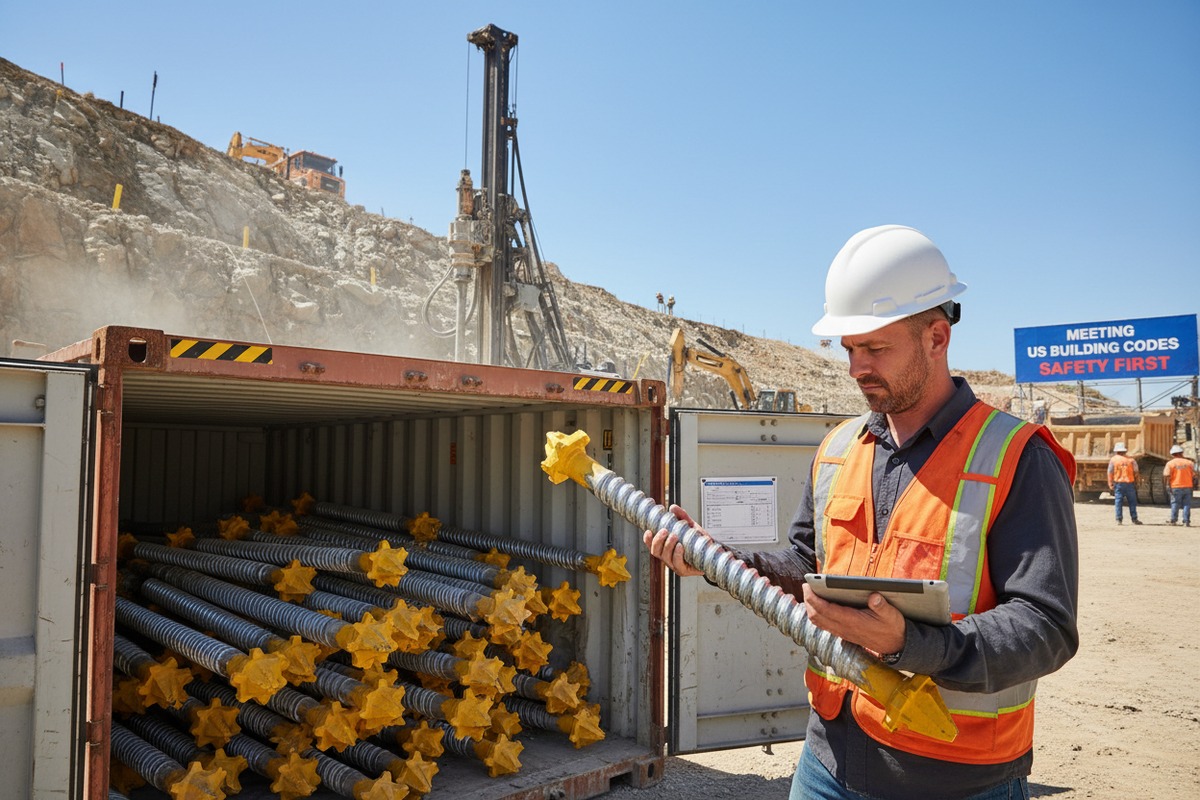
For US-bound anchor bolt shipments, you must correctly classify the product under HTS code 7318.15, determine applicable Section 301 tariffs (currently 25%), check for anti-dumping and countervailing duties on Chinese steel fasteners, provide compliant commercial invoices and packing lists, and evaluate Buy America Act restrictions for federally funded projects.
HTS Classification: Getting the Code Right
The Harmonized Tariff Schedule 9 (HTS) code determines your duty rate. Self-drilling anchor bolts typically fall under HTS 7318.15 (screws and bolts of iron or steel). However, if your SDA system includes bearing plates, nuts, and couplers, those components may classify separately under 7318.16 (nuts) or 7326.90 (other articles of iron or steel).
Misclassification is a serious risk. If US Customs and Border Protection (CBP) determines that your product was classified under a lower-duty code, you face penalties, back-duties, and potential seizure. We always recommend working with a licensed US customs broker who specializes in steel products.
Section 301 Tariffs and AD/CVD Duties
Since 2018, Chinese steel products entering the US face a 25% Section 301 tariff on top of the base duty rate. This alone adds significant cost to your self-drilling anchor bolt purchase.
But there is an even bigger risk: anti-dumping duties (AD) and countervailing duties (CVD). Certain Chinese steel fasteners have been subject to AD/CVD orders that can exceed 200% of the declared value. Whether your specific SDA product falls under an existing AD/CVD order depends on the exact HTS classification and the scope of the order. A customs attorney or trade compliance specialist can conduct a scope ruling analysis to determine your exposure.
Buy America and Buy American Act
These are two different requirements, and confusing them is common.
- Buy American Act (BAA): Applies to federal government procurement. Requires that manufactured goods be produced in the US with at least 55% domestic components (increasing to 75% by 2029 under Executive Order 14005).
- Buy America (23 CFR 635.410): Applies to federally funded highway and transit projects. Requires that all iron and steel be manufactured in the US, including the manufacturing process from initial melting through final coating.
Chinese-sourced SDAs cannot meet Buy America unless they are reprocessed (melted and manufactured) in the US—which defeats the purpose of importing. For federally funded projects, you will need to either source domestically or secure a non-availability waiver from the Federal Highway Administration (FHWA). These waivers are difficult to obtain and require documented evidence that no domestic supplier can provide the product in the needed timeframe and quantity.
Required Shipping Documents
Every US-bound shipment of self-drilling anchor bolts from China should include:
- Commercial invoice with unit prices, total value, HTS codes, and country of origin
- Packing list with bundle counts, weights, and dimensions
- Bill of lading (ocean) or air waybill
- Material Test Reports (MTRs) for each heat number
- Certificate of Origin
- Fumigation certificate (if wooden packaging is used)
- ISF (Importer Security Filing) submitted 24 hours before vessel loading
Cost Impact Summary
| Cost Factor | Typical Rate / Amount | Notes |
|---|---|---|
| Base duty rate (HTS 7318.15) | 0–6.2% | Depends on specific subheading |
| Section 301 tariff 10 | 25% | Applies to most Chinese steel products |
| Anti-dumping duty (if applicable) | 0–200%+ | Scope ruling required; varies by product |
| Countervailing duty (if applicable) | 0–50%+ | Scope ruling required |
| Customs broker fee | $150–$500 per entry | Per shipment |
| Third-party US lab testing | $3,000–$5,000 per container | Tensile, chemical, coating tests |
| Freight (FOB China to US port) | $3,000–$8,000 per 20ft container | Varies by route and season |
Practical Advice for Importers
Start your tariff analysis before you finalize pricing with your Chinese supplier. A product that looks cheap on an FOB basis can become uncompetitive after duties stack up. We provide DDP (Delivered Duty Paid) quotes to US customers who prefer a single landed price with no surprises. This shifts the customs risk to us, and our logistics partners handle the classification and duty payments on your behalf.
Also, keep records meticulously. CBP can audit imports up to five years after entry. If your documentation is incomplete, you may owe back-duties plus interest and penalties.
Conclusion
Sourcing self-drilling anchor bolts from China for US projects demands careful attention to ASTM standards, ICC-ES certifications, material verification, and customs compliance. Get these right, and you protect your project, your budget, and your reputation.
Footnotes
- Provides general background on anchor bolt types and uses. ↩︎
- Information on the American Welding Society and its structural codes. ↩︎
- Information on ground anchor installation and testing standards. ↩︎
- Explains the process and standards for hot-dip galvanization. ↩︎
- Official site of the American Welding Society. ↩︎
- Details on the international standard for testing and calibration laboratories. ↩︎
- Official source for the International Building Code requirements. ↩︎
- Reference for transportation-related material standards. ↩︎
- Official US government portal for tariff classification. ↩︎
- Background on Section 301 trade enforcement actions. ↩︎