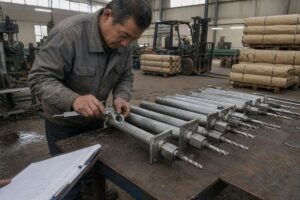

Sourcing self-drilling anchor bolts from China sounds simple until a shipment fails an ASTM pull test or gets stuck at US customs. Our production floor in Shandong processes over 30,000 tons annually, and we have watched importers lose months of project time because they skipped proper supplier qualification.
To qualify a Chinese supplier for self-drilling anchor bolt exports to the US, verify ASTM compliance through third-party testing, audit the factory's production capacity and quality management systems, confirm their DDP shipping and customs clearance capabilities, and review their track record on US infrastructure projects.
This guide walks you through each step. We will cover technical standards, factory audits, logistics, and project experience—so you can build a reliable supply chain without costly surprises.
How do I verify if a Chinese supplier's self-drilling anchor bolts meet US technical standards?
When we ship our R32 and T76 hollow bar anchors to US job sites, every batch goes through strict material and dimensional testing before it leaves the warehouse. Yet many importers still receive bolts that do not match the specs they ordered.
Verify compliance by requesting mill test certificates, checking ASTM F1554 or A193 conformance, sending samples to an independent US-accredited lab for tensile and pull-out tests, and confirming the supplier holds ISO 9001 and CE certifications relevant to anchor bolt manufacturing.

Why US Standards Matter for Self-Drilling Anchors
Self-drilling anchor bolts are hollow, threaded rods used in geotechnical engineering 1. They stabilize rock and soil in tunneling, mining, slope reinforcement, and construction pits. Because they stay in the ground permanently—no rod removal needed—their material strength and thread integrity are critical. A bolt that fails underground can cause a collapse.
The US market relies on ASTM standards 2 to define minimum performance. If your bolts do not meet these, they cannot be used on federally funded or code-compliant projects.
Key Standards to Check
| Standard | What It Covers | Why It Matters |
|---|---|---|
| ASTM F1554 | Anchor bolts for structural applications | Defines grade 36, 55, and 105 yield strength requirements |
| ASTM A193 | Alloy and stainless steel bolting materials | Covers high-temperature and high-pressure service |
| ASTM A615 | Deformed steel bars (rebar-type threads) | Relevant for ribbed anchor bolt shafts |
| ISO 9001 3 | Quality management system 4 | Proves the factory has repeatable QC processes |
| CE Marking | European conformity | Signals international quality benchmarks accepted in many US specs |
Step-by-Step Verification Process
First, ask the supplier for recent mill test certificates. These documents show the steel grade, chemical composition, and mechanical properties of the raw material. Compare the values against ASTM minimums.
Second, request physical samples. Send them to an independent lab in the US—SGS, Bureau Veritas 5, or a university testing facility. Run tensile tests, yield strength tests, and if possible, pull-out tests in simulated ground conditions.
Third, check certifications. ISO 9001 is the baseline. CE and SGS inspection reports add confidence. Be cautious if a supplier claims ASTM compliance but cannot produce any third-party test report.
Fourth, compare Chinese GB standards with US ASTM standards. They are not identical. Our engineering team regularly maps GB/T 3098 (Chinese fastener mechanical properties) against ASTM equivalents. Some properties overlap, but thread tolerances and proof load definitions differ.
China GB vs. US ASTM: A Quick Comparison
| Parameter | China GB/T 3098 | US ASTM F1554 Grade 55 |
|---|---|---|
| Minimum Yield Strength | Varies by class (e.g., 8.8 = 640 MPa) | 380 MPa (55 ksi) |
| Minimum Tensile Strength | 800 MPa (Class 8.8) | 517 MPa (75 ksi) |
| Elongation (min) | 12% | 21% |
| Thread Tolerance System | GB/T 197 (ISO metric) | ASME B1.1 (Unified) or metric per project spec |
| Proof Load Testing | Required per class | Required per grade |
Notice that elongation requirements can differ significantly. A bolt that passes Chinese GB tests may not meet the ductility requirement in ASTM F1554. This is why independent testing is non-negotiable.
Watch for Red Flags
In 2021, roughly 15% of Chinese fastener exports were returned due to quality issues. Common problems included incorrect steel grades, shallow thread depth, and inconsistent heat treatment. If a supplier refuses to provide samples or gets defensive about third-party testing, move on.
Also consider anti-dumping duties. The US has imposed duties on certain Chinese carbon steel fasteners. Confirm the Harmonized Tariff Schedule 6 code for your specific anchor bolts. Self-drilling hollow bar anchors may classify differently than standard hex bolts, which can affect duty rates.
What should I look for when auditing a manufacturer's production capacity and quality control process?
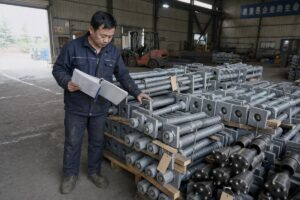
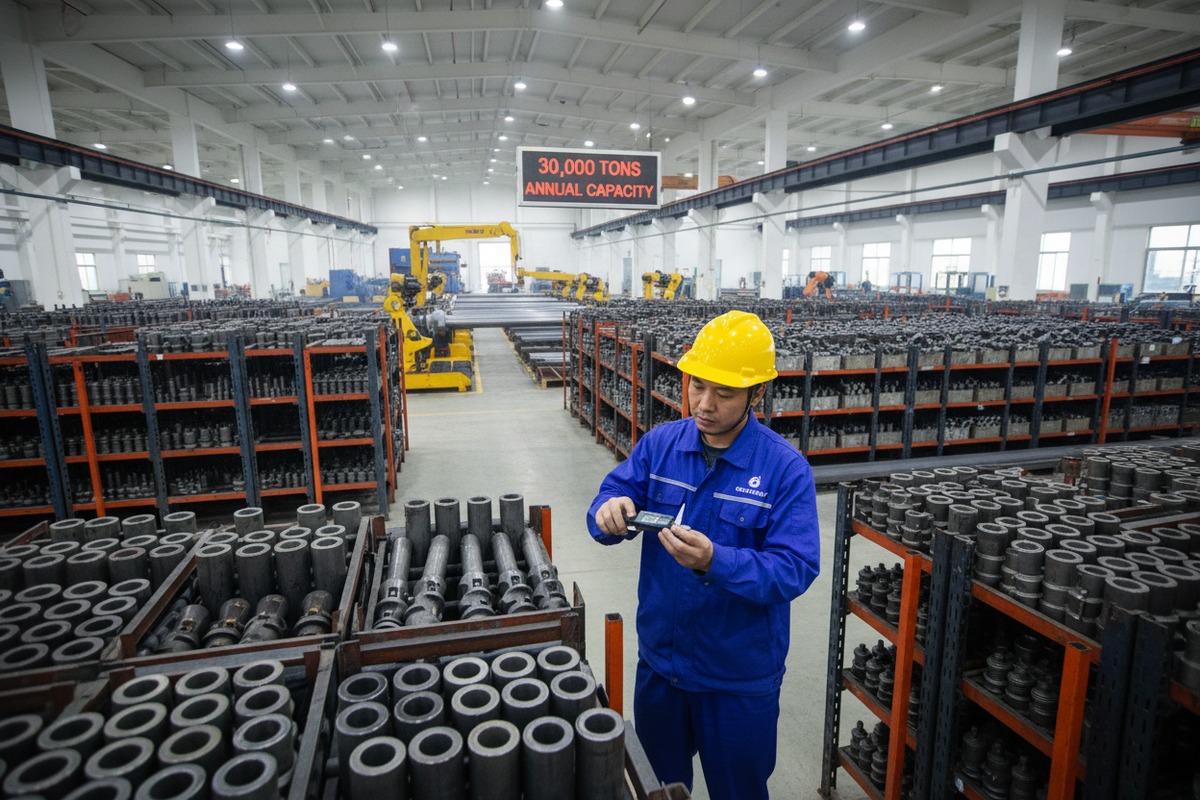
Walking through our Shandong facility, visitors often notice the raw steel inventory yard before anything else—over 2,000 tons in stock at any given time. That stockpile exists because we learned early that US contractors cannot wait eight weeks for raw material procurement when a tunnel project is behind schedule.
When auditing a Chinese anchor bolt factory, inspect raw material sourcing and storage, evaluate CNC threading and heat treatment equipment, review in-process QC checkpoints, confirm annual production tonnage against your order volume, and verify the workforce's technical training records.
Production Capacity Check
Start with numbers. Ask the supplier for their annual output in tons. Compare it against your projected annual demand. A factory producing 30,000 tons per year can comfortably handle a 500-ton order without disrupting other clients. A factory producing 3,000 tons per year may struggle with the same order.
Check equipment age and type. Modern CNC thread-rolling machines 7 produce more consistent threads than older manual lathes. Look at the heat treatment furnace—does it have programmable temperature controls, or is it manually operated? Inconsistent heat treatment is the number-one cause of brittle anchor bolts.
Quality Control Checkpoints
A serious factory has QC at every stage, not just before shipping. Here is what a proper QC flow looks like:
| Stage | QC Action | Tool/Method |
|---|---|---|
| Incoming raw material | Chemical composition test, diameter check | Spectrometer, calipers |
| After cutting | Length tolerance verification | Measuring tape, go/no-go gauge |
| After threading | Thread pitch and depth inspection | Thread gauge, profile projector |
| After heat treatment | Hardness test, microstructure check | Rockwell hardness tester, metallographic microscope |
| Assembly (plate + nut) | Torque test, dimensional fit | Torque wrench, assembly jig |
| Pre-shipment | Visual inspection, random pull test, packaging check | Third-party inspector or in-house QC team |
If the factory cannot describe these stages clearly, or if they skip heat treatment testing, that is a serious concern.
What to Observe During a Site Visit
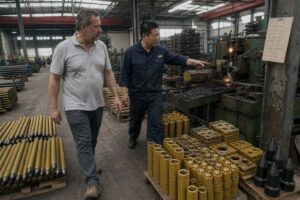
Look at the shop floor, not the showroom. Is it organized? Are work orders visible at each station? Our facility uses tracking cards attached to each batch—these follow the steel from cutting through packaging. Ask to see a batch card and trace it backward.
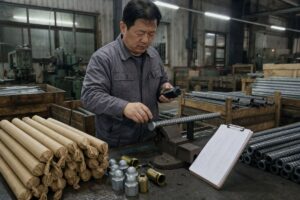
Check the testing lab. Does the factory have its own tensile testing machine? A Rockwell hardness tester? A spectrometer for steel grade verification? Factories that outsource all testing may face delays in catching defects.
Talk to the QC manager, not just the sales team. Ask about their defect rate. Any factory claiming zero defects is not being honest. A healthy defect rate for anchor bolt manufacturing is below 2%, with clear corrective action records for each incident.
Third-Party Inspection
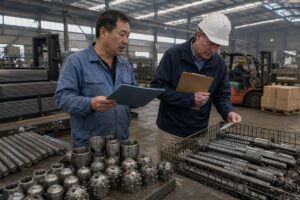
Even after a successful audit, use pre-shipment inspection by a third party like SGS or Bureau Veritas. They will pull random samples, measure dimensions, run hardness tests, and verify packaging matches the order specification. This costs a few hundred dollars per inspection and has saved our clients tens of thousands in rejected shipments.
Workforce and Training
A 100-person team with dedicated QC staff is different from a 100-person team where the sales manager also does quality checks. Ask how many full-time QC inspectors are on staff. Ask if operators receive annual training on equipment operation and safety standards. Well-trained operators produce fewer defective bolts.
How can I ensure my Chinese partner manages DDP shipping and US customs clearance effectively?
Our logistics team handles DDP shipments to ports across the US West Coast and East Coast every month. The biggest lesson we have learned is that customs clearance problems almost always trace back to missing paperwork—not the bolts themselves.
Ensure effective DDP shipping by confirming the supplier uses a licensed US customs broker, requesting copies of all trade documents in advance, verifying the correct HTS code to calculate anti-dumping duties, and building a 15–20 day buffer into your project timeline for potential customs holds.
What DDP Actually Means for You
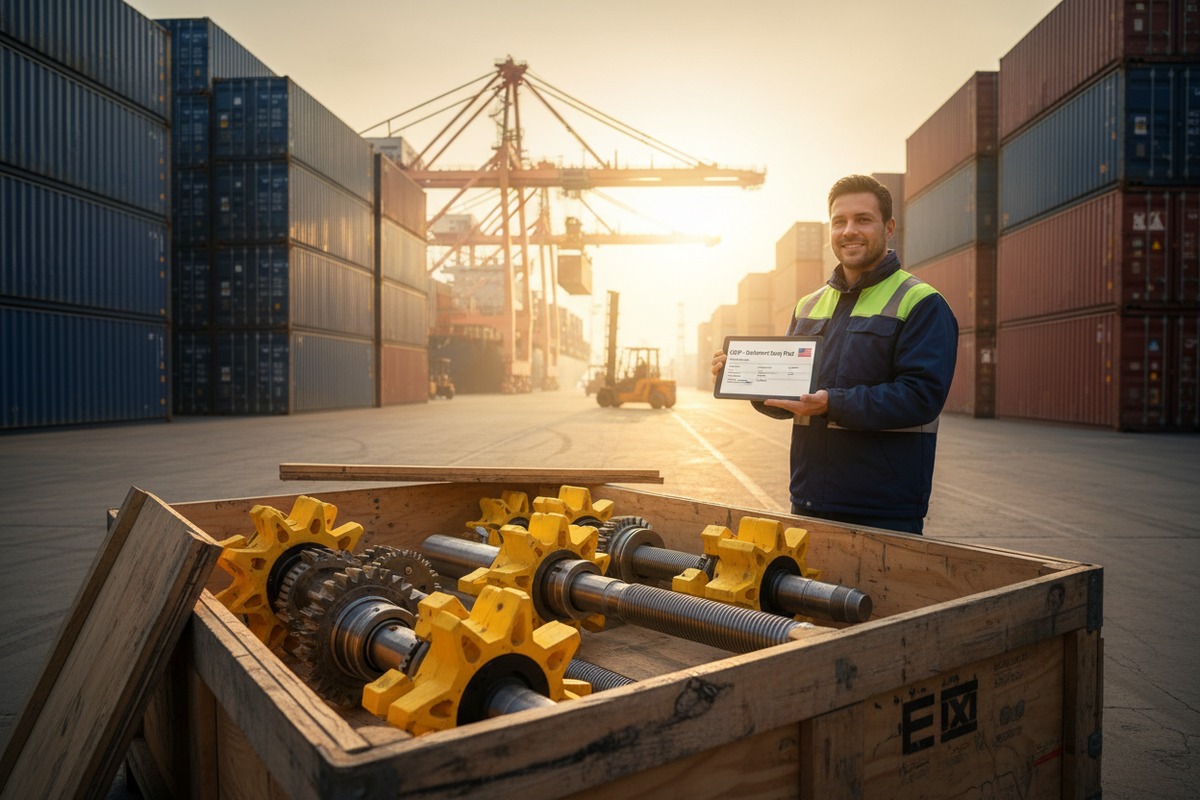
DDP—Delivered Duty Paid—means the supplier handles everything: ocean freight, insurance, US customs entry, duty payment, and delivery to your door or job site. You pay one price. But "handles everything" only works if the supplier has real experience doing it.
Ask the supplier who their US customs broker is. A reliable broker knows how to classify self-drilling anchor bolts under the Harmonized Tariff Schedule. Misclassification can trigger audits, penalties, or unexpected duty charges.
Anti-Dumping Duties on Chinese Fasteners
The US has active anti-dumping duty orders 8 on certain Chinese carbon steel fasteners. Self-drilling hollow bar anchors may or may not fall under these orders depending on their HTS classification. The difference between "bolt" and "anchor system" in customs language can mean a duty rate swing of 0% to over 100%.
Work with your customs broker to get a binding ruling from US Customs and Border Protection if you are unsure. This ruling locks in the classification and duty rate for your product.
MOFCOM End-User Statements
For shipments of items on the Commerce Control List 9 exceeding $50,000 in value, China's Ministry of Commerce may require an end-user statement. This document declares who the final buyer is and what the product will be used for. If your anchor bolts are going to a mining project, state that clearly. Vague end-use descriptions can trigger delays.
There are 31 Export Control Classification Numbers that may require a military end-use license. Self-drilling anchor bolts for civilian geotechnical use are unlikely to fall into these categories, but if your project has any government or defense adjacency, verify this early.
Documentation Checklist for Smooth Clearance
Make sure your supplier provides all of the following before the shipment departs China:
- Commercial invoice with accurate unit prices and HTS codes
- Packing list with net and gross weights per carton or pallet
- Bill of lading (ocean) or air waybill
- Certificate of origin
- Mill test certificates for the steel
- Third-party inspection report (if applicable)
- MOFCOM end-user statement (if required)
- Anti-dumping duty deposit calculation (if applicable)
Missing even one document can hold your container at the port for weeks. We prepare a pre-shipment document package and send it digitally before the vessel departs. This gives the customs broker time to pre-clear or flag any issues.
Build a Timeline Buffer
Ocean freight from China to the US West Coast takes about 14–18 days. Customs clearance typically takes 3–5 business days if documents are clean. But if CBP selects your container for examination, add another 7–14 days. Always build a 15–20 day buffer beyond the estimated arrival date before you promise delivery to your project site.
What are the best ways for me to evaluate a supplier's experience with large-scale US infrastructure projects?
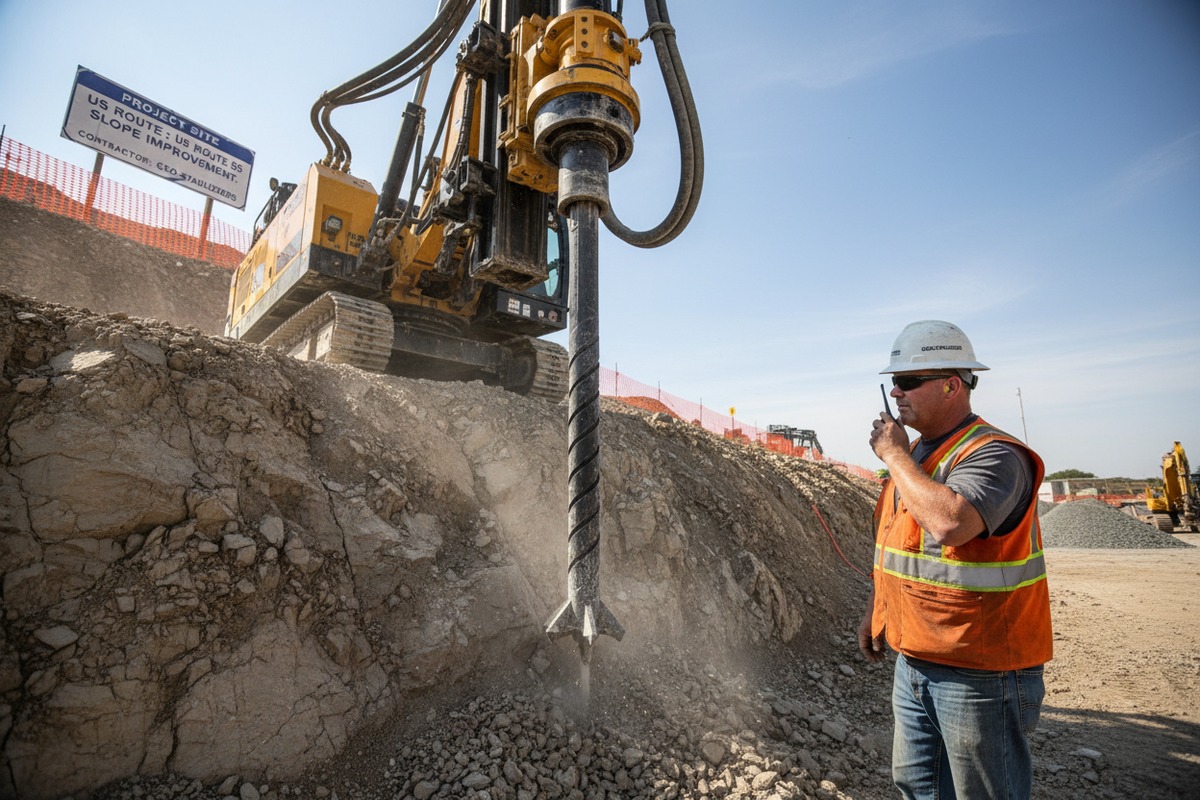
We have shipped self-drilling anchor systems to highway slope stabilization projects in the western US and tunnel support 10 jobs on the East Coast. Each project taught us something new about American engineering specs, inspection expectations, and delivery pressure.
Evaluate a supplier's US project experience by requesting case studies with verifiable project names, contacting their US buyer references directly, reviewing their ability to provide custom lengths and thread types, and confirming they understand American engineering submittal and documentation requirements.
Ask for Specific Case Studies
A supplier who has worked on US infrastructure projects should be able to name them—or at least describe the project type, location, bolt specification, and volume. General claims like "we export to many countries" are not enough.
Look for details: What anchor diameter was used? R32, R38, T76? What drill bit type? What grout was specified? How many tons were shipped over what period? Specificity signals real experience.
Contact References Directly
Ask for two or three US buyer contacts. Call or email them. Ask about on-time delivery, quality consistency, responsiveness to problems, and willingness to handle warranty claims. If the supplier hesitates to provide references, treat that as a warning sign.
Evaluate Customization Capability
US infrastructure projects often require non-standard configurations. A tunnel in soft ground may need a longer coupling length. A slope project in expansive clay may need a specific drill bit geometry. The supplier should offer OEM and ODM services—not just sell from a fixed catalog.
Our facility, for example, produces custom lengths from 1 meter to 6 meters, multiple thread standards (R, T, IBO), and various drill bit types (cross, clay, tricone) based on ground conditions. This flexibility matters when a US engineer specifies something outside the standard product range.
Understand the Submittal Process
On US infrastructure projects, the contractor must submit product data sheets, mill test certificates, and sometimes shop drawings to the engineer of record for approval before installation begins. This is called the submittal process. A supplier unfamiliar with this will not prepare documents in the format the engineer expects.
Ask the supplier: "Can you provide a submittal package?" This package should include product technical data, material certifications, dimensional drawings, and installation guidelines—all in English, all in US-standard units (inches, ksi, psi).
Geopolitical and Supply Chain Risk Assessment
US-China trade tensions continue to evolve. Tariffs, export controls, and political shifts can disrupt supply chains overnight. Evaluate whether the supplier has a contingency plan. Do they maintain US warehouse stock? Do they work with multiple freight forwarders? Can they reroute shipments if a port is congested?
Digital traceability is also growing in importance. Some US project owners now require blockchain-verified material origin or IoT-tracked shipments. Ask the supplier if they can support these requirements or are willing to adopt them.
Supplier Scorecard
Build a simple scorecard to compare multiple Chinese suppliers side by side:
| Criteria | Weight | Supplier A Score (1–10) | Supplier B Score (1–10) |
|---|---|---|---|
| ASTM compliance (verified by lab) | 20% | — | — |
| Production capacity vs. your demand | 15% | — | — |
| QC process maturity | 15% | — | — |
| DDP shipping experience to US | 15% | — | — |
| US project references (verified) | 15% | — | — |
| Customization capability | 10% | — | — |
| Communication and responsiveness | 5% | — | — |
| ESG and sustainability practices | 5% | — | — |
Score each supplier honestly. Weight the criteria based on your project priorities. A supplier scoring 8+ across the board is worth a long-term partnership. One scoring below 5 in any critical area needs improvement before you commit volume.
Think Long-Term
Chinese self-drilling anchor bolts cost roughly 30% less than Western equivalents. That savings is real, but only if quality holds up over time. The best way to protect that cost advantage is to invest in supplier qualification upfront and maintain ongoing monitoring. Annual audits, quarterly sample testing, and regular communication keep the relationship healthy and the quality consistent.
Conclusion
Qualifying a Chinese self-drilling anchor bolt supplier takes effort, but it protects your projects, your budget, and your reputation. Verify standards, audit the factory, confirm logistics capability, and check real project references—then build a partnership that lasts.
Footnotes
1. Defines the engineering field where self-drilling anchor bolts are primarily utilized for stabilization. ↩︎
2. Provides the technical specifications and performance requirements for anchor bolts in US construction. ↩︎
3. Directs to the official ISO page detailing the 9001 quality management standard. ↩︎
4. Explains the framework for consistent manufacturing quality as defined by international standards. ↩︎
5. Global leader in testing, inspection, and certification services for industrial products. ↩︎
6. Official US resource for classifying imported goods and determining applicable duty rates. ↩︎
7. Technical background on the machinery used to produce high-precision threads in manufacturing. ↩︎
8. Official government information on trade enforcement actions affecting imported Chinese fasteners. ↩︎
9. Provides official US government guidelines on the Commerce Control List. ↩︎
10. Overview of engineering methods used to stabilize underground excavations in civil projects. ↩︎