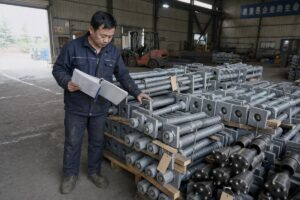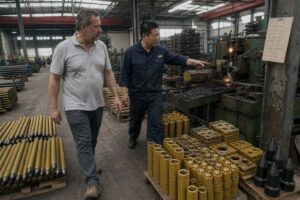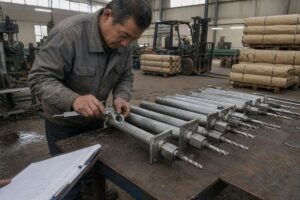
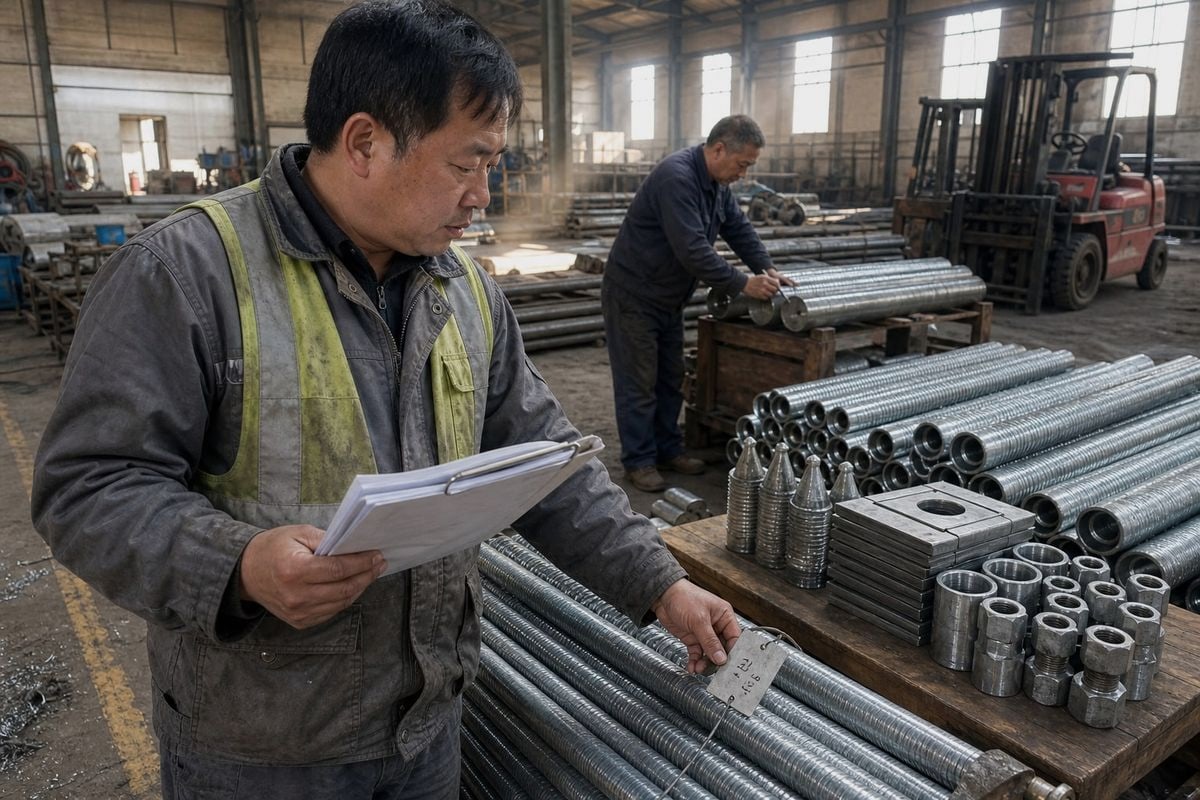
Traceability certificates for self-drilling anchor bolts are the first thing I check before any container leaves our Shandong plant. Without them, one bad heat can stall your entire tunnel project.
To ensure your supplier provides traceability certificates for self-drilling anchor bolts, write the full document package into your RFQ and purchase order: Material Test Reports with heat numbers, EN 10204 3.1 certificates, test results for every system component, and shipment-level batch traceability that matches the physical markings.
That is the short answer. Now let me walk you through each step, from the documents you request to keeping records valid for years after delivery.
What Documents Should I Request to Verify Full Material Traceability?
A buyer from Norway once rejected a competitor's shipment because the paperwork covered only the hollow bar, not the couplers. In our export files, every component gets its own record.
Request a Material Test Report (MTR/MTC) per heat number, an EN 10204 3.1 certificate, a certificate of conformance to the specified standard, third-party test reports, coating documentation, and batch traceability records covering the bolt, coupler, nut, plate, and drill bit.
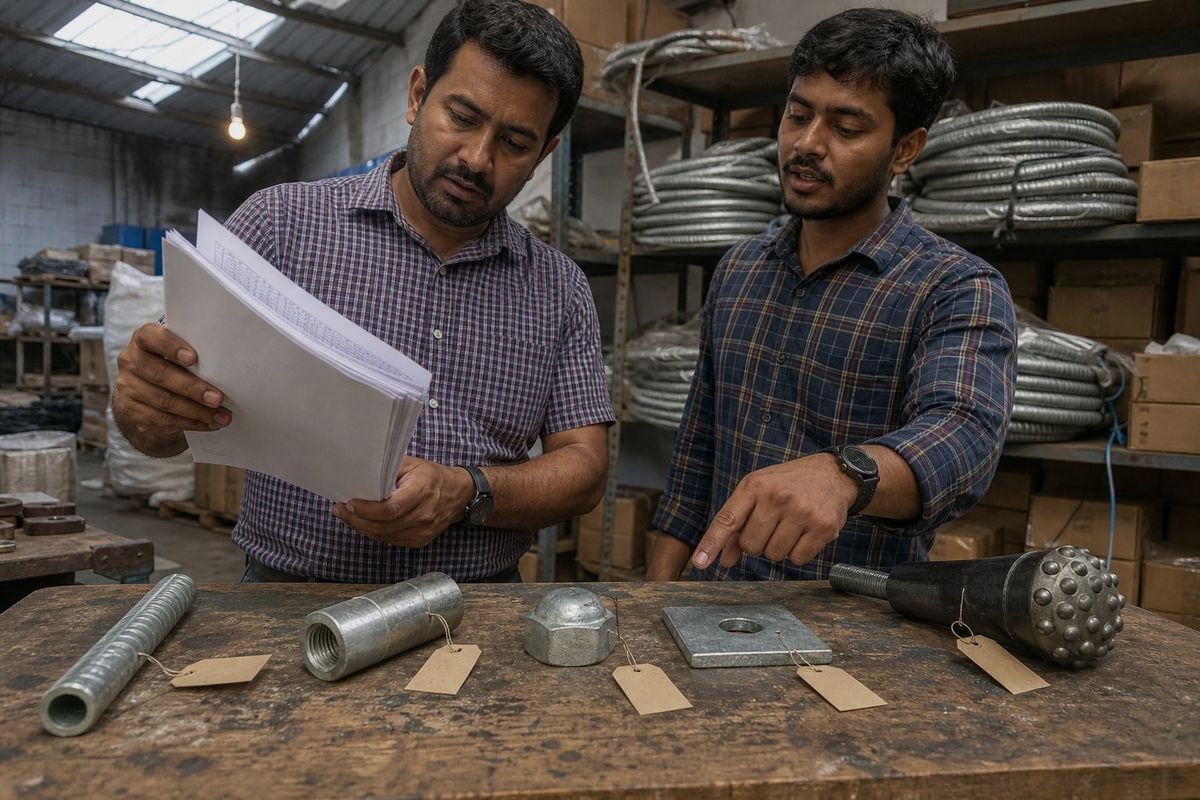
The biggest mistake I see buyers make is asking for "a certificate" in the singular. A self-drilling anchor bolt is a system product, not a single fastener. The hollow bar, the coupling sleeve, the hex nut, the bearing plate, and the sacrificial drill bit all carry load together. If one component fails, the anchor fails. So the paperwork must cover the whole system, and it must trace each part back to its raw material source.
The Core Document Package
Here is the minimum set of documents I recommend you name explicitly in your purchase order:
| Document | What It Proves | Key Detail to Check |
|---|---|---|
| Material Test Report 1 (MTR/MTC) | Chemical composition and mechanical properties of the steel | Heat number must match bar markings |
| EN 10204 certification (Type 3.1) | Tests were performed by the manufacturer's independent inspection department | Issuing party and test date listed |
| Certificate of Conformance | Product meets the specified standard and grade | Standard, grade, and lot quantity stated |
| Third-party test reports | Tensile, proof load, hardness, or impact results verified externally | Test standard referenced, sample lot identified |
| Coating documentation | Zinc thickness or coating weight for corrosion resistance 2 | Measurement method and acceptance criteria |
| Batch traceability record | Chain from raw material producer to shipped lot | Raw material mill named, processing route shown |
Why the Heat Number Is the Anchor of Everything
A heat number ties a specific melt of steel to specific test results. When our quality assurance team stamps bundles before packing, that number is what lets an engineer on a jobsite in Chile prove the bar in the ground is the same steel that passed the tensile test. If a certificate has no heat number, or the number does not appear on the goods, the document is close to worthless for project acceptance. Public guidance on anchor bolts is blunt about this: bolts that cannot be identified or traced to shipment documentation should be sampled and retested, or rejected outright. Demand the heat number on every page.
How Do I Confirm My Supplier's Certificates Meet International Quality Standards?
When we ship to the USA, Norway, and Saudi Arabia in the same month, our team juggles three different acceptance regimes. That experience taught me that a certificate is only as good as the standard behind it.
Confirm certificates by checking three things: the standard cited (ASTM, ISO, or EN) matches your project specification, the certificate type is EN 10204 3.1 or higher, and the issuer is verifiable through the certifier's official directory or a live validation channel.

Many suppliers advertise "CE," "ISO," or "SGS audited" on their websites. Those labels are useful signals of process maturity. But they answer different questions, and buyers often mix them up. An ISO 9001 certificate 3 covers the management system of the factory. A CE mark covers a product's conformity route. Neither one proves that the specific lot in your container was tested and traced. You need shipment-level evidence on top of those labels.
Certificate Types Under EN 10204
The EN 10204 certification framework defines who performed and validated the tests. This distinction matters enormously for geotechnical engineering projects 4 where downstream acceptance depends on documented evidence:
| Certificate Type | Who Tests | Suitable For |
|---|---|---|
| Type 2.1 | Manufacturer declares conformity, no test results | Non-critical commodity items only |
| Type 2.2 | Manufacturer, results not lot-specific | Low-risk applications |
| Type 3.1 | Manufacturer's independent inspection department, lot-specific results | Standard for anchor bolt acceptance |
| Type 3.2 | Manufacturer plus buyer's representative or third party | High-consequence infrastructure and cold-service projects |
Matching the Standard to the Project
Ask what standard the mechanical properties were tested against. ASTM standards 5 dominate North American specs, while EN and ISO norms govern most European tunneling work. A tensile result is meaningless if it was tested under one standard but your project engineer accepts under another. In our experience exporting to both markets, the safest move is to state the exact standard, grade, and test method in the purchase order before production starts. Then verify the issuer. Ask for the certificate number and check it against the certification body's online directory. Fraudulent or recycled certificates exist in this industry, and a five-minute lookup during supplier vetting can save a rejected shipment.
What Steps Can I Take to Audit a Supplier's Traceability System Before Ordering?
An American procurement manager once asked me to trace a random coupler from our stock back to its steel mill during a video call. It took us eleven minutes. That test told her more than any brochure could.
Audit a supplier before ordering by requesting a sample traceability package, performing a random back-trace test on stocked goods, reviewing how heat numbers survive cutting and threading, checking subcontractor controls, and confirming markings on physical products match the digital records.
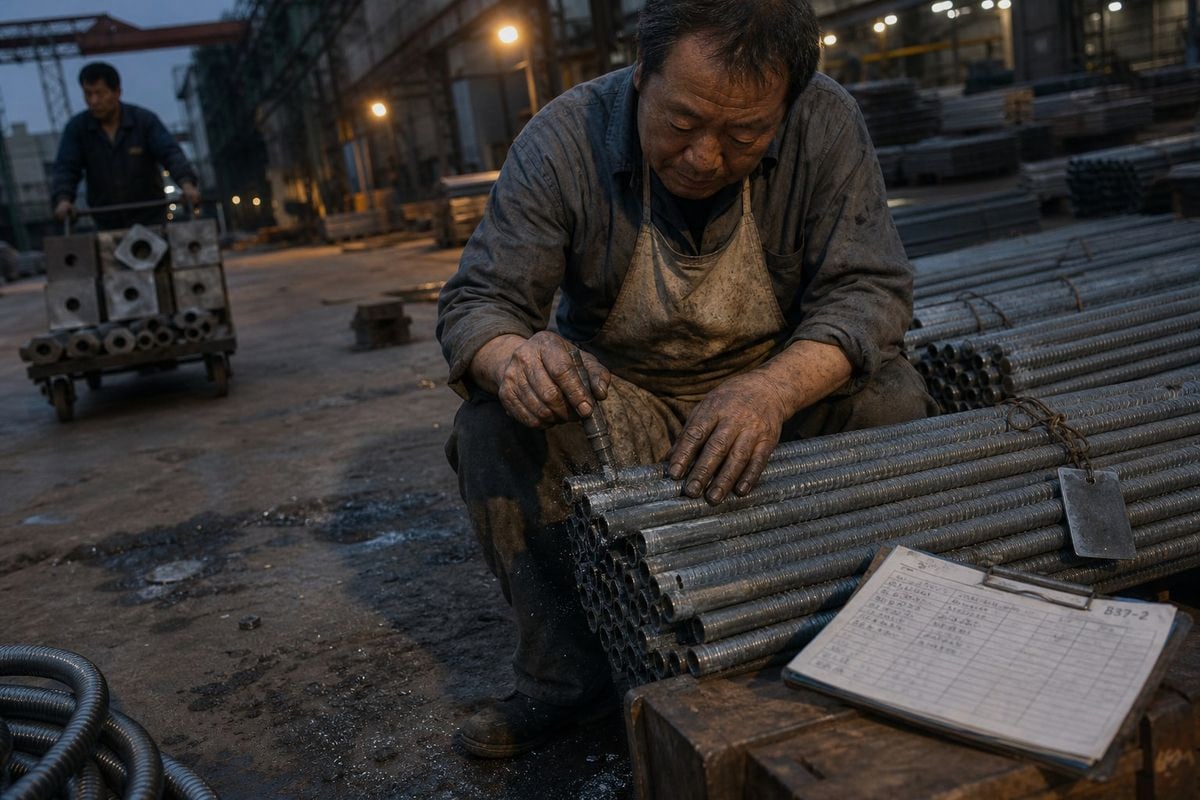
You do not need to fly to China to audit supply chain traceability 6. Most of the work can be done remotely if you structure it as a process. Here is the sequence I suggest to buyers who visit our Alibaba storefront or find us through trade shows:
- Request a sample document package from a past shipment (with the customer name redacted). Check whether it includes heat numbers, raw material mill identification, test dates, and component-level coverage.
- Run a live back-trace test. Pick any bar or coupler in the supplier's warehouse during a video audit. Ask them to pull the MTR, the production batch record, and the incoming raw material certificate for that exact item. A real system answers in minutes. A paper-only system stalls.
- Probe the transfer points. Traceability usually breaks where material changes form: cutting, threading, heat treatment, galvanizing. Ask how the heat identity follows the bar through each step and through any subcontracted process.
- Check marking durability. Stamped marks, tags, or barcodes must survive handling, sea freight, and outdoor storage. Ink-jet marks that wipe off in transit destroy batch traceability at the worst possible moment.
- Review quarantine procedures. Ask what happens when a lot fails testing. A supplier with no documented quarantine and disposition process will eventually ship you a failed lot by accident.
Do Not Forget the Physical Side of the Audit
Documents are only half the story. Packing quality decides whether those documents still match usable goods on arrival. A Canadian buyer we supported purchased heavy cargo from a factory that stacked pallets too high and too heavy. By the time the goods reached our warehouse, the pallets had tilted and the cartons had deformed. We re-palletized everything before loading the container, which saved the sailing but cost time. For anchor bolts, I apply the same lesson: single pallets over 800 kg go on reinforced double-faced hardwood pallets, loads over 1.2 tons get extra bottom skids, and we use strapping bands plus stretch film, never film alone. Ask your supplier to describe their palletizing standard during the audit. Crushed bundles with torn tags mean lost lot identity, extra re-handling fees, and sometimes a missed vessel.
How Do I Ensure Traceability Records Stay Valid Throughout My Project's Lifecycle?
The trade-off I weigh most often is between paperwork depth and procurement speed. Some buyers see traceability as overhead that slows ordering. Two decades of shipping anchor systems to tunnels and mines convinced me otherwise.
Keep records valid by matching certificates against packing lists and product markings at receipt, storing digital and physical copies linked by lot number, controlling partial usage of lots, requiring records for replacement orders, and defining retention periods that outlast the structure's design life.
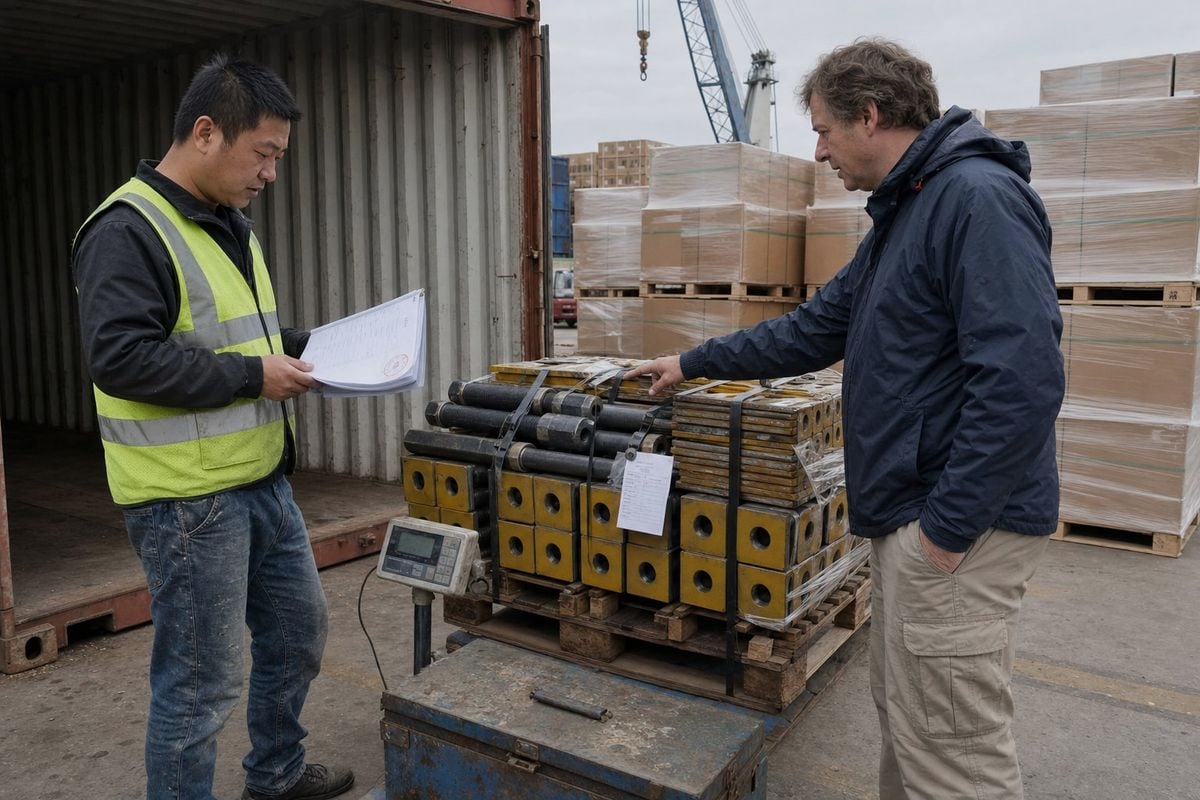
Traceability does not end when the container clears customs. It ends when the last anchor is grouted, tested, and signed off — and in liability terms, it never really ends. If an anchor system fails five years into service, the traceability file is what separates a quick root-cause analysis from a legal nightmare. That is the rebuttal to the "paperwork overhead" objection: traceability is not bureaucracy, it is risk control against safety, liability, and schedule consequences.
The Four-Way Match at Receipt
At goods receipt, verify four things against each other. If any one fails, quarantine the lot before it mixes into site stock:
| Item | Check Against | Common Failure |
|---|---|---|
| Certificate | Packing list quantities and lot numbers | Certificate belongs to a different shipment |
| Packing list | Physical bundle count and tags | Bundles combined or re-tagged in transit |
| Product markings | Heat number on the MTR | Generic certificate with no heat number |
| Physical goods | Thread fit, coupler interface, coating condition | Coating damage not reflected in documents |
Managing Records Over Time
Once the four-way match passes, discipline keeps the chain intact. Store each certificate digitally under its lot number, and keep the file linked to installation records showing where each lot went into the ground. When a lot is split across work fronts, log the split. When you reorder, require the new shipment's documents rather than reusing old ones — mechanical properties vary by heat, and yesterday's certificate proves nothing about today's steel. For harsh environments, keep the corrosion resistance evidence, such as galvanizing thickness reports, in the same file, because coating life is often the limiting factor in the design. Some of our infrastructure clients now request barcoded tags so site engineers can scan a bundle and pull the record instantly; a few are exploring digital-twin style records for critical anchors. Finally, agree on a retention period in writing. We keep production and quality assurance records well beyond delivery, and I advise buyers to retain their copies for at least the design review life of the structure.
Conclusion
Do not ask for a certificate; demand a verifiable chain from mill heat to installed anchor. Write it into the PO, audit it before ordering, and match it at every receipt.
Footnotes
1. Defines Material Test Reports (MTRs) and their importance for material quality and traceability. ↩︎
2. Provides a scientific overview of corrosion resistance and methods to prevent material degradation. ↩︎
3. Provides an overview of the ISO 9001 standard for quality management systems. ↩︎
4. Defines geotechnical engineering and its scope in construction and infrastructure projects. ↩︎
5. Introduces ASTM International and its role in developing and publishing voluntary consensus standards. ↩︎
6. Explains supply chain traceability, its importance, and how it is implemented in various industries. ↩︎