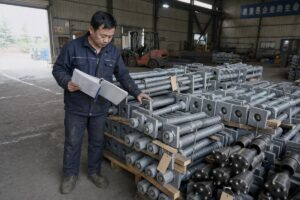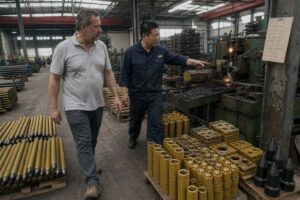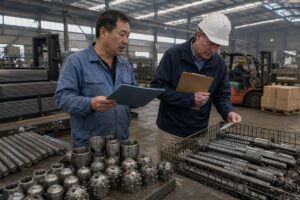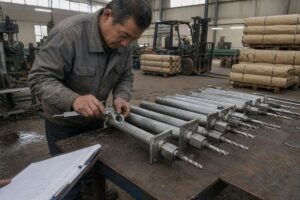

Missed delivery dates on anchor bolts can stall an entire foundation pour, idle expensive drilling rigs, and cascade delays across every trade that follows. Having managed production schedules 1 on our shop floor for over twenty years, we have seen small procurement oversights balloon into six-figure project losses. The good news is that most of those losses are preventable once you know what drives lead times.
To evaluate self-drilling anchor bolt lead times, project managers should confirm supplier production capacity, map freight and customs durations, quantify the impact of custom specifications, and build schedule buffers of 10–15%. Standard production runs typically ship in one to three weeks, but galvanizing, custom threads, or large batches can extend that timeline significantly.
This guide breaks the evaluation process into four practical questions. Each section gives you concrete steps, benchmark data, and risk-mitigation tactics 2 you can apply right away. Let's start with the most time-sensitive issue: matching a supplier's real capacity to your deadline.
How can I verify if a supplier's production capacity aligns with my project's urgent deadlines?
When a project schedule is tight, the first temptation is to accept a supplier's quoted lead time at face value. On our production line, we handle dozens of concurrent orders, and we know that quoted lead times are best-case estimates unless you dig deeper into current shop-floor reality.
Verify capacity by requesting a supplier's current order backlog, confirmed weekly output in tons, raw-material stock levels, and references from recent rush-order clients. Cross-check their annual capacity claim against actual shipment records, and ask whether overtime or second-shift options exist for expedited runs.
Ask for Real Numbers, Not Marketing Numbers
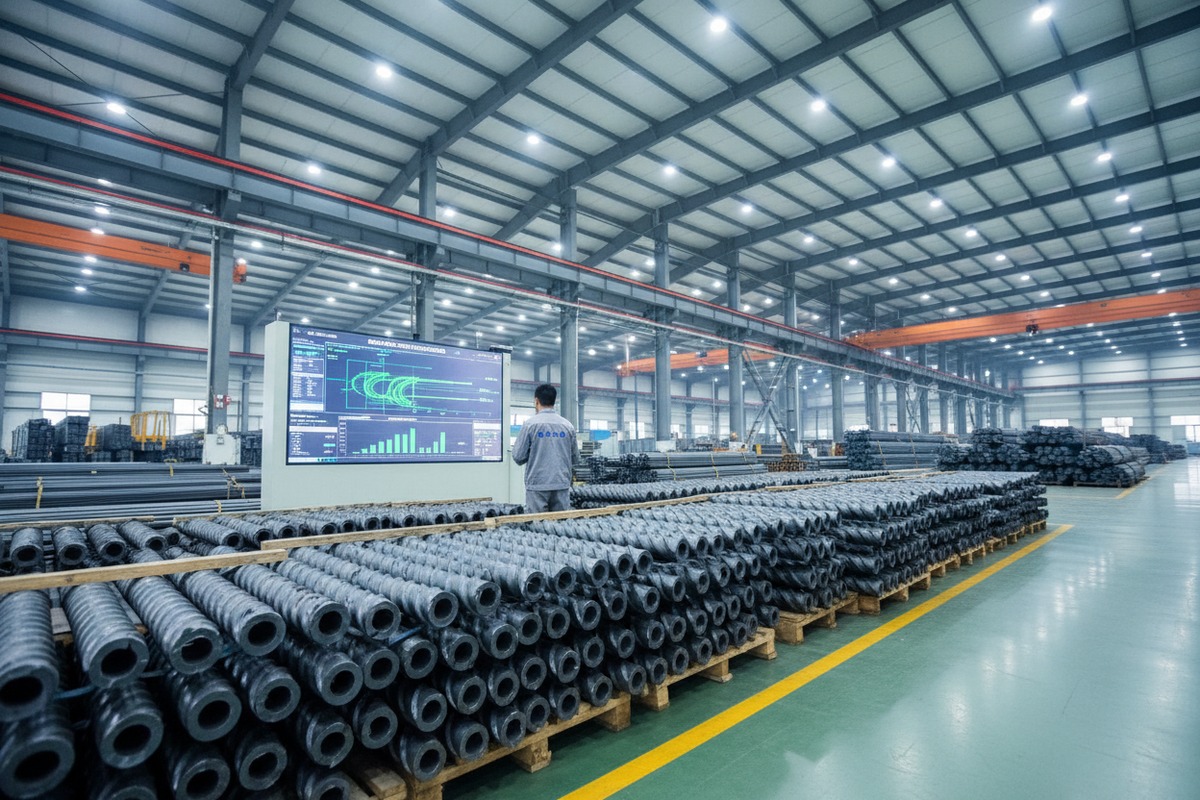
Many suppliers advertise annual output figures—our own facility, for example, has an annual capacity of 30,000 tons with a standing stock of 2,000 tons. But annual capacity tells you nothing about availability next Tuesday. The questions that matter are:
- What is your current backlog in weeks?
- How many tons per week can you allocate to a new order?
- Do you hold standard R25, R32, or R38 hollow bars 3 in stock right now?
If the answers are vague, that is a red flag. A transparent supplier will share a production calendar 4 or at least tell you which machine centers are bottlenecked.
Benchmark Manufacturing Cycle Times
Understanding what happens on the factory floor helps you spot unrealistic promises. Below is a simplified breakdown of the major operations for a batch of self-drilling anchor bolts.
| Operation | Typical Setup Time | Run Time per Batch | Notes |
|---|---|---|---|
| Steel bar shearing | 20 min | Varies by length | Hollow bar cut to specified lengths |
| Upsetting / forging | 25 min | 25–40 min | Forms coupler or head geometry |
| Thread rolling | 15 min | 43 min | Continuous spiral thread on hollow bar |
| Heat treatment | — | 4–8 hours | Batch furnace cycle; adds ~1 day |
| Hot-dip galvanizing | — | 3–5 days | Often outsourced; queue-dependent |
| QC & mill test certs | — | 1–2 days | Tensile, torque, and dimensional checks |
A sample batch can require roughly three hours of direct labor before heat treatment and coating even begin. Scale that by your order volume and the number of permutations (different diameters, lengths, bit types), and you can model a realistic production window.
Evaluate Rush-Order Feasibility
Rush orders are usually possible but come at a cost—typically 1.5× the standard labor rate due to overtime. More importantly, rush runs break batch efficiencies. Instead of grouping similar diameters, the shop must reset tooling more often. Our experience shows that a rush order of mixed R32 and R38 bolts takes nearly twice the per-unit time compared with a planned single-diameter run.
Ask your supplier directly: "If I need 10 tons of R38 self-drilling bolts delivered EXW in 10 days, can you commit? What is the upcharge?" A credible supplier will give you a firm yes or no within 24 hours.
What logistics factors should I account for when importing anchor bolts from China to my job site?
Freight planning is where many procurement managers underestimate the calendar. We ship containers from Shandong province to ports across five continents, and we have learned that the ocean is only one part of the journey. Inland trucking, customs clearance, and port congestion routinely add days that nobody budgeted for.
When importing self-drilling anchor bolts from China, account for factory-to-port trucking (1–3 days), ocean freight (15–40 days depending on destination), customs clearance and inspection (3–7 days), and last-mile delivery to your job site. Add a 10–15% logistics buffer to cover port congestion, documentation errors, and seasonal surges.

Mapping the Full Transit Chain
The total transit time is never just the sailing schedule. Here is a realistic breakdown for a typical shipment from our Shandong facility to a U.S. Gulf Coast project site.
| Leg | Duration | Variables |
|---|---|---|
| Factory to Chinese port (truck) | 1–3 days | Distance to Qingdao or Shanghai |
| Port handling & customs export | 1–2 days | Documentation completeness |
| Ocean freight 5 to Houston | 28–35 days | Carrier schedule, transshipment |
| U.S. customs clearance | 3–7 days | HS code 6 accuracy, inspection lottery |
| Port to job site (truck) | 1–3 days | Distance, oversize load permits |
| Total estimate | 34–50 days | Add 10–15% buffer |
For European destinations like Norway or Italy, ocean freight drops to roughly 25–30 days, but customs within the EU can add its own layer of paperwork. Chilean or Peruvian routes often involve transshipment in Panama, adding three to five days.
Key Documentation That Causes Delays
Missing or inaccurate paperwork is the number-one cause of customs hold-ups we see. Make sure your supplier provides:
- Commercial invoice 7 with correct HS codes for hollow steel bars
- Packing list with exact weights and dimensions per crate
- Mill Test Certificates (MTCs) matching the purchase order
- Certificate of Origin 8 if preferential tariff rates apply
- Fumigation certificate for wooden crating
One wrong digit on the HS code can trigger a physical inspection that adds five or more business days. HS codes 9 We always recommend that buyers confirm documentation templates before production starts—not after the container is loaded.
Seasonal and Geopolitical Disruptions
Chinese New Year shuts most factories for two to three weeks every January or February. Port congestion spikes before and after the holiday. If your project needs material in Q1, place your order no later than early December. Similarly, infrastructure spending cycles in the Middle East and South America create seasonal demand surges in Q3 and Q4, which can stretch production queues industry-wide.
Tariff changes and trade-policy shifts—particularly between the U.S. and China—can also affect landed costs overnight. Building DDP (Delivered Duty Paid) terms into your contract with a supplier who has experience navigating these duties, as we do for many U.S. clients, removes a significant layer of risk from your schedule.
How does choosing customized or OEM anchor bolt specifications impact my overall procurement timeline?
Almost every geotechnical project we supply requires some degree of customization—whether it is a non-standard length, a particular drill bit geometry for cobblestone ground, or a corrosion-resistant coating mandated by the specification. These variables are easy to overlook when you are focused on unit price, but they can add one to three weeks to your procurement timeline if you do not plan ahead.
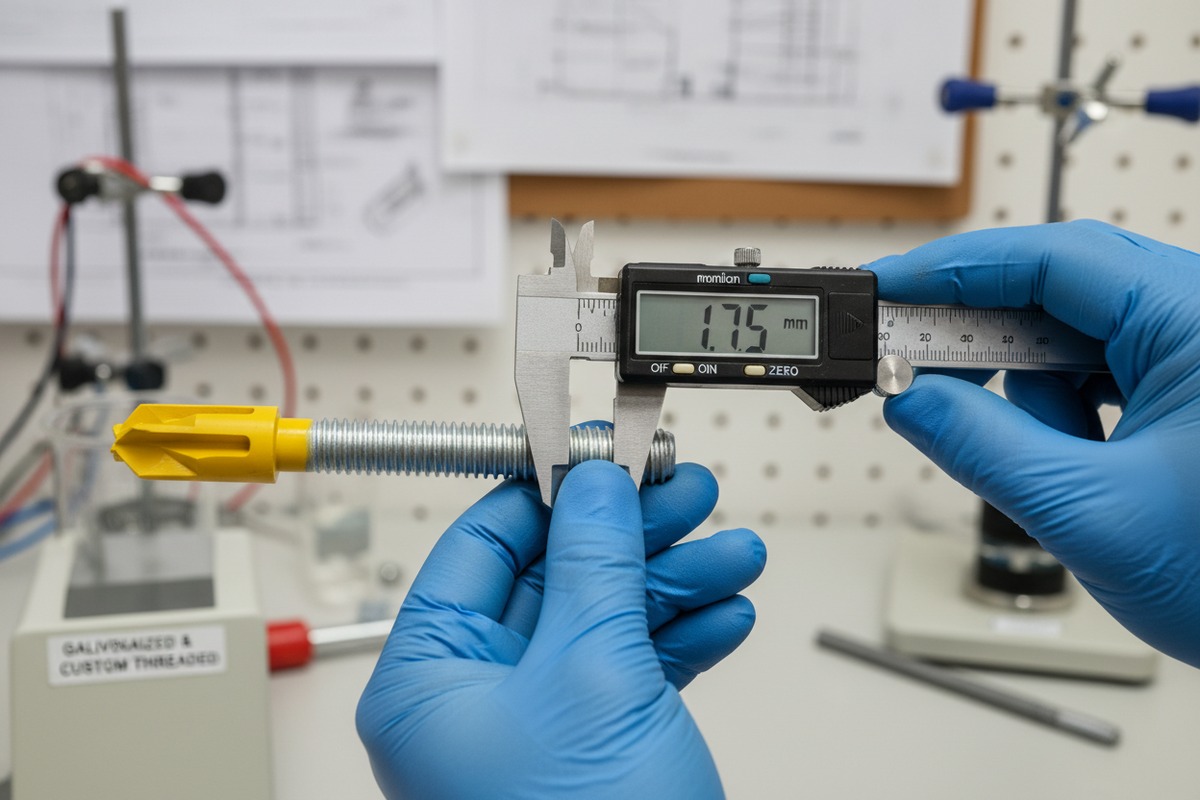
Customized or OEM self-drilling anchor bolts typically add one to three weeks beyond standard lead times due to tooling setup for non-standard threads, specialized coatings like hot-dip galvanizing or epoxy, and additional QC rounds. Semi-custom options using pre-qualified dimensions can cut this extension by roughly 50%.
What Counts as "Custom"?
Not all modifications carry the same time penalty. Here is a practical way to categorize requests.
| Customization Level | Examples | Added Lead Time |
|---|---|---|
| Stock / standard | R32 or R38 hollow bar, standard bit, no coating | 0 days (ships from inventory) |
| Semi-custom | Non-standard cut length, specific coupler type | 3–5 days |
| Full custom | Unique thread pitch, special OEM branding, epoxy + galvanize dual coat | 7–21 days |
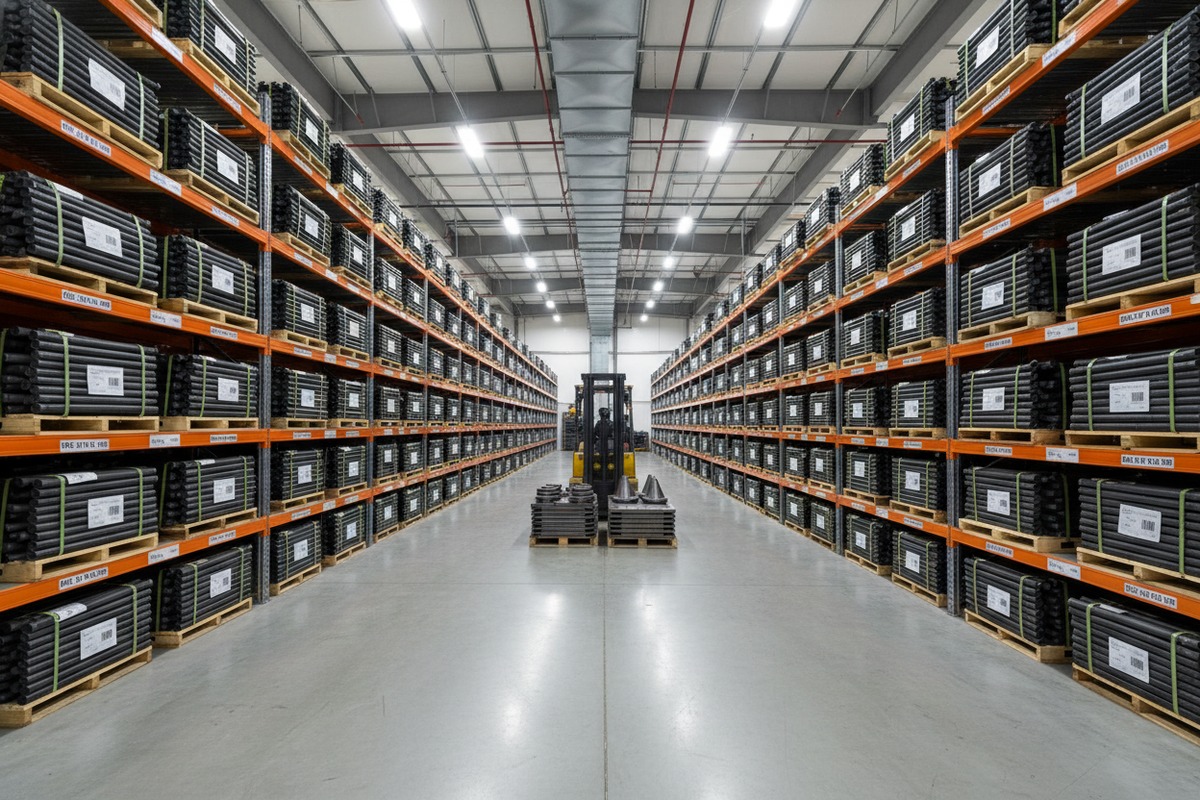
Our facility keeps roughly 2,000 tons of standard R25, R32, and R38 bars in stock at any time. If your project spec aligns with these sizes, we can often ship within days. But once you move into full-custom territory—say, a unique diameter with an anti-corrosion epoxy topcoat for a marine tunnel—the timeline stretches because tooling, coating, and testing cycles stack on top of each other.
The Coating and Treatment Bottleneck
Hot-dip galvanizing alone typically adds three to five days if done in-house, or up to a week if outsourced to a third-party galvanizer with its own queue. Epoxy coating requires curing time. If your specification calls for both galvanizing and epoxy—an increasingly common requirement in green infrastructure bids—plan for an additional 7 to 14 days.
Heat treatment is another hidden time-eater. Self-drilling anchor bolts destined for high-load geotechnical applications usually require quench-and-temper processing. A furnace cycle takes 4 to 8 hours, but batch scheduling means your order may wait a day or two for the next open slot.
Strategies to Shorten Custom Lead Times
- Finalize specs before RFQ. Late design changes are the single biggest cause of reorders. Coordinate with your geotechnical engineer to lock bolt diameter, length, thread profile, and coating before you contact any supplier.
- Use a pre-approved vendor list. If you work with a supplier who already has your thread profile tooling on file—like repeat clients we serve in Chile and Norway—setup time drops dramatically.
- Order in phases. If you need 50 tons total but only 10 tons for the first pour, split the PO. The first batch ships fast from standard stock while the custom batch goes through its full cycle.
- Request a production timeline document. Any credible OEM supplier should provide a Gantt-style timeline showing each manufacturing step and its duration for your specific order.
Sustainability-driven specs are also growing. Corrosion-resistant coatings and recyclable packaging mandates add one to two weeks but are increasingly non-negotiable in government-funded infrastructure bids. Build these into your baseline assumptions rather than treating them as surprises.
What steps can I take to mitigate the risk of shipment delays affecting my geotechnical project schedule?
A single delayed container of self-drilling anchor bolts can idle a drilling rig, a grouting crew, and a supervision team all at once. The material itself may represent less than 5% of the project budget, but the downstream cost of a stalled foundation phase can be enormous. We have seen projects in Southeast Asia and South America lose entire weeks because a shipment was held at customs over a paperwork discrepancy.
Mitigate shipment delay risks by building a 10–15% schedule buffer into your critical path, ordering anchor bolts in staggered shipments, pre-clearing customs documentation, synchronizing bolt deliveries with grouting materials and rig availability, and maintaining a secondary supplier relationship for emergency stock.
Build Lead Times into Your Critical Path Method (CPM) Schedule
Anchor bolt procurement belongs on the critical path of any foundation or ground-support scope. Treat it the same way you treat structural steel or pre-cast segments. In your CPM or Gantt chart, create a task line that includes:
- Specification finalization
- RFQ and PO issuance
- Production window
- Factory QC and packing
- Freight and customs
- Site receiving and inspection
Assign realistic durations to each line item using the benchmark data from the earlier sections of this article. Then add your 10–15% buffer as a separate contingency task at the end.
Staggered Shipment Strategy
Rather than shipping 100% of your bolt order in one container, consider splitting it into two or three shipments:
- First shipment (30–40% of quantity): Covers the initial foundation phase. Ship by express sea freight or even air freight if the project is critically time-sensitive.
- Second shipment (40–50%): Ships on standard ocean freight, timed to arrive as the first batch is being consumed.
- Third shipment (remaining 10–20%): Acts as a reserve. This batch can incorporate any specification adjustments discovered during the initial installation phase.
This approach costs slightly more in freight but dramatically reduces the risk of a total work stoppage.
Synchronize with Complementary Materials
Self-drilling anchor bolts are useless without grouting materials 10, drill bits, couplers, centralizers, and a functioning drilling rig. A common mistake is ordering bolts on time but forgetting that the grouting cement has its own lead time, or that the rig is committed to another site. Create a synchronized procurement checklist:
- Hollow bar anchors (R25/R32/R38)
- Drill bits matched to ground conditions
- Couplers and plates
- Cement or resin grout (check shelf life)
- Drilling rig mobilization schedule
All five items must converge on the same date. If any one item is late, the others sit idle.
Maintain a Secondary Supplier Relationship
Even with the best planning, unforeseen ground conditions—say, hitting an unexpected gravel layer at depth—can force a change in bolt specification mid-project. Having a pre-qualified secondary supplier who carries standard stock means you can place an emergency order and receive material in days rather than weeks. We encourage our long-term clients to keep our standard R32 and R38 specs on file so that emergency re-orders skip the specification phase entirely.
Monitor and Communicate Proactively
Set up weekly status calls with your supplier during the production and shipping window. Ask for container tracking numbers the day the shipment leaves port. Use real-time vessel tracking tools to monitor transit and anticipate arrival windows. Proactive communication catches problems early—when solutions are still cheap—rather than at the job site gate when they are expensive.
Conclusion
Evaluating self-drilling anchor bolt lead times is a scheduling discipline, not just a purchasing task. Verify capacity, map logistics, plan for custom specs, and build buffers. Your project timeline depends on it. Contact us at sales@sdarockbolt.com for a detailed production timeline tailored to your next order.
Footnotes
1. Explains the concept and importance of production scheduling. ↩︎
2. ISO provides international standards and frameworks for effective risk management principles. ↩︎
3. Describes the properties and uses of hollow steel bars in engineering. ↩︎
4. NIST MEP offers resources for manufacturing production, capacity planning, and supply chain optimization. ↩︎
5. The Federal Maritime Commission regulates ocean freight and international maritime commerce. ↩︎
6. The International Trade Administration explains the Harmonized System codes used in global trade. ↩︎
7. Explains the purpose and requirements of a commercial invoice for customs. ↩︎
8. Defines the Certificate of Origin and its role in international trade. ↩︎
9. Provides an overview of the Harmonized System (HS) codes for classifying goods. ↩︎
10. Explains what grout is and its various applications in construction. ↩︎